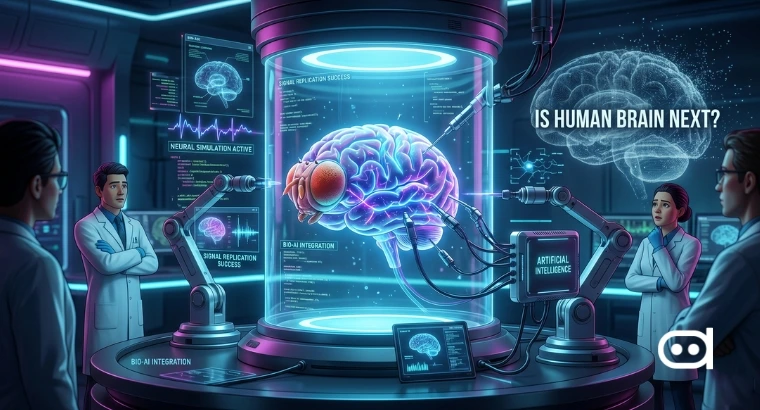
- Scientists at a start up have managed to simulate a fruit fly’s brain inside an artificial system, which lets it move and respond to stimuli almost like a real insect.
- They pulled this off by using detailed neural mapping along with AI to mimic how a fly’s brain processes information in a virtual world.
- The results, reported in April 2026, show that this digital fly can actually display lifelike behaviour.
A team of researchers did just that, starting small. The idea was to take a brain, map it neuron by neuron, and run that map inside a machine. They recreated a fruit fly brain, plugged it into a digital body, and watched as the virtual insect behaved like the real thing. There weren’t any separate lines of code for every behaviour, the digital fly’s actions came straight from simulated neural activity. It navigated its environment, reacted to what it saw, and acted in a way that looked similar to a real fly.
At its core, this experiment marks a major shift in how we build AI. Instead of training algorithms on huge piles of data to mimic results, these researchers tried to copy the actual biological structure behind those results. In other words, they weren’t aiming to teach a machine what to do; they were trying to build the system that decides what to do itself. The digital fly only did simple things, but the implications are huge, and stretch into some of the boldest questions in science and technology.
From Neural Maps to Digital Behavior
This whole project rests on connectomics, the science of mapping all the neural connections in a brain. Using high-res imaging, the team rebuilt the fruit fly’s entire neural circuit: about 140,000 neurons, with millions of connections. They then turned this map into a computer model that could show how those signals move around the network.
The biggest deal here isn’t just the accuracy of the map, it’s the result. The simulated brain didn’t get explicit instructions for what to do, its behavior actually grew out of how its virtual neurons interact. In the digital world, the model-based fly could move toward food, react to cues, and behave with what looked like basic instinct.
This is quite different from the way conventional AI works. Most AI rely on memorizing patterns and statistics. Here, the focus is on making things feel biologically real. By copying the structure of a living brain, these scientists are trying to capture the actual mechanics of intelligence and not just its outward appearance.
From Flies to Humans
Naturally, after an achievement like this, everyone starts talking about what’s next: simulating the human brain. The team thinks their approach could someday scale, letting us build digital replicas of far more complex organisms. In theory, if we could map and simulate every neuron and connection in the human brain, we might be able to recreate parts of memory, thought, or even personality.
But bringing that to life is a whole other challenge. The human brain has around 86 billion neurons, way more than a fruit fly’s. The human brain isn’t even fully mapped out yet, and if it was, puzzles about consciousness and subjective experience aren’t sorted out.
Critics point out that simulating a brain’s structure doesn’t mean you’re capturing what really matters. A digital model might act like a brain in some ways, but that doesn’t mean it’s aware of anything. There’s a giant gap between acting like you’re conscious and actually being conscious, and that’s not just a philosophical point, it’s a problem for science, too.
Also read: Anthropic’s Meeting with the White House: Who Sets the Limits for AI?
Conclusion
This experiment isn’t a shortcut to digital immortality, but it is proof that behavior can come from simulated neural systems. It suggests that AI, built with inspiration from biology, might help us crack the secrets of intelligence. At the same time, the road ahead is long. Moving from a virtual fruit fly to a digital human mind is less about scale and more about understanding. For now, this work is both a milestone and a reality check: making life, even in digital form, is way more complicated than just copying a blueprint.