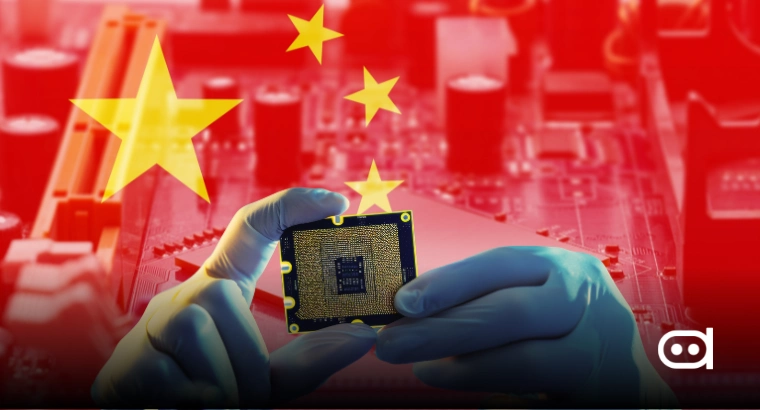
Over the past year, China has rolled out competitive AI models and built up their domestic semiconductor industry. The latest development of a Chinese chip reportedly delivering up to 478 times better performance than Nvidia’s A100 GPU on a specialized computing task adds another milestone to that trajectory.
That eye catching number only applies to a specific scientific workload, not general AI tasks. Still, there is more to it than just a benchmark. The real story here is how quickly China’s AI tech is evolving, not just with hardware, but with software and research too. No, this does not mean China has surpassed the world’s AI leaders. But it is proof that they are closing those critical technological gaps much faster than a lot of people expected.
How China’s AI Ecosystem Advanced Upto This Speed
The progress did not come out of nowhere. China has not put all its chips on just building bigger language models. They have been working on everything at once: semiconductor manufacturing, infrastructure, cloud, university research, etc. That broad focus let them keep pushing the boundaries, even as access to the world’s most cutting edge AI became harder to get. Instead of backing down, they focused on building homegrown alternatives and reduce their reliance on foreign suppliers.
The pace of their innovation has become noticeable over the past two years. Chinese companies are launching smarter AI models, hardware firms are making solid progress with AI accelerators for business and research, and universities are intensifying innovative chip architectures built for scientific computing. All these developments reflect how China’s AI ambitions extend far beyond building individual products. They are building an entire ecosystem that can cover all fronts of artificial intelligence.
Why China’s 478x Brain-Mapping Chip Isn’t Replacing NVIDIA
The latest breakthrough has attracted attention because researchers reported that their chip achieved up to 478 times higher performance than Nvidia’s A100 GPU for a specialized neuroscience related computing task. However, this figure should be interpreted within its proper context. This chip is built for digital brain simulations and a narrow set of scientific workloads. Its architecture is totally different from Nvidia’s general GPUs that power everything from massive language models to image generators and recommender systems.
So, saying it is 478 times faster does not mean it will beat Nvidia at everything. Nvidia still rules when it comes to general AI training because of their mature GPU ecosystem and top notch software tools. Still, the breakthrough shows that Chinese talent for custom hardware is catching up fast. As AI spreads into new fields like healthcare, robotics, advanced research, you can’t just rely on one chip to do it all. Specialized accelerators are going to be the future. The race is not just about building the fastest all purpose AI processor. Leading the race means tailoring chips for the needs of specific industries and workloads.
🚨 CHINA JUST BUILT A CHIP THAT OUTPERFORMS NVIDIA BY UP TO 478 TIMES ON SPECIFIC AI TASKS.
— Bull Theory (@BullTheoryio) July 5, 2026
Researchers from Peking University developed a neuromorphic chip that can reconstruct complex brain surfaces in under half a second.
The key difference from a standard GPU is… pic.twitter.com/vSQrVSyprA
What this Means for the Global AI Race
China’s latest tech marks a real change in how we think about the AI race. The competition is evolving from a race centered on frontier language models into a broader contest involving semiconductors, research capabilities, manufacturing capacity, and long term technological independence.
Their strategy is to strengthen every piece of the supply chain. From chip design to cloud infrastructure to applications, it is all coordinated. This strategy enables continued progress even when external restrictions affect access to advanced foreign technologies.
Also read: Taiwan’s AI Chip Export Curbs Could Redefine China’s Technology Ambitions
As AI integrates itself deeper into economies, healthcare, defense, manufacturing, and science, the real leaders will be those investing everywhere, not just relying on one product or service. China’s new chip is another sign that their long term approach is starting to pay off with visible, measurable progress. So yes, the “478x” stat grabbed all the attention but the real takeaway is not about a single benchmark. It is about China’s AI ecosystem picking up speed and depth, even with geopolitical hurdles and tech blockades in the way.