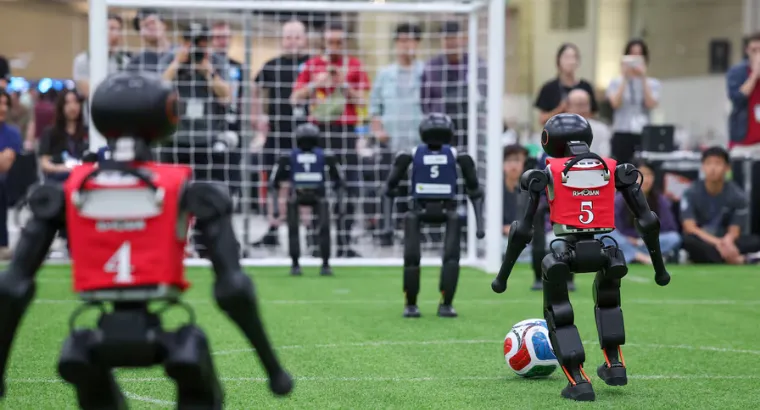
The beginning of RoboCup 2026 in Incheon, highlighted by RoboCup, is deemed to be the world’s biggest and most crucial artificial intelligence and robotics competition. Conducted at Songdo Convensia in Yeonsu-gu, Incheon, the program brought together several researchers, developers, engineers, and humanoid robots from around the world. With robots playing soccer in front of crowds, RoboCup once again depicted how a sport is being used as a mechanism for advanced AI, robotics, and sovereign systems. At RoboCup 2026 in Incheon, humanoid robots appalled viewers by playing soccer in ways that resemble human capabilities.
Who Was a Part of RoboCup 2026 Incheon?
What makes RoboCup distinct is its magnitude, vision, and background. It was started in 1997 and has expanded into a worldwide platform where artificial intelligence and robotics development are tested under real-world and real-time conditions. Often known as the World Cup of Robots, RoboCup reflects the architecture and ambition of global football tournaments, using them as its testing mechanism. What expands RoboCup beyond other robotics events is its long-standing goal, which is to develop an entirely sovereign humanoid robot capable of defeating the human FIFA World Cup champions by the year 2050.
This ambition drives the program’s rules, technicalities, standards, and worldwide attraction, pushing the competitors to develop perception, balance, tactics, decision-making, and cooperative play. Over nearly 30 years, RoboCup has developed into a massive, perennial artificial intelligence and robotics competition around the world, serving as a foundation for sovereign systems research.
This year’s tournament marked a massive participation in the history of RoboCup, with 3,000 athletes from 45 countries competing across leagues. Teams secured their places through native and preliminary rounds, ensuring that only top-performing teams reached the main tournament. The magnitude of participation emphasizes RoboCup’s worldwide reach and its necessity to universities, developers, researchers, and robotic teams across the globe.
In the humanoid soccer league, the competition was claimed by Tsinghua University’s THU Robotics Hephaestus team, which defended its title after also winning the previous competition in Salvador, Brazil. Enterprises and institutional backing further pushed the event. KB Financial Group was the key sponsor, joined by other robotics and industry niche partners, emphasizing strengthened industry interest in RoboCup’s technologies.
Also Read: Meituan’s LongCat 2.0 Turns a Model Launch Into a Compute Sovereignty Statement
Why Is RoboCup 2026 Significant?
At RoboCup 2026 in Incheon, humanoid robots appalled viewers by playing football in ways that resemble human tactics. Robots passed the ball to build attacks, defended the ball, and attempted mid-range shots by assessing their opponent’s weaknesses. These videos unfolding in front of spectators depicted how sovereign decision-making and motion have developed. Similarly, the match revealed the issues that remain constant. Robots constantly lose balance and fall during the play, and many require help from their teams to stand back up.
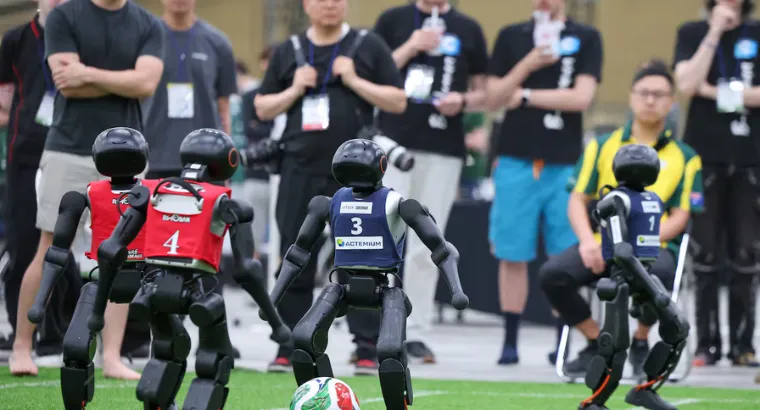
Movements were less active than those of human players, but the pace was immaculate. Analysts noted that the gap between human and humanoid motion is decreasing as artificial intelligence patterns and hardware continue to develop. By placing robots in complex, real-time, unpredictable conditions, RoboCup continues to develop real-world stress tests for artificial intelligence systems.
RoboCup’s importance is far beyond entertainment or games. The championship has become a worldwide mechanism for artificial intelligence and robotics that can be helpful for healthcare, manufacturing, disaster response, and sovereign mobility. By pushing robots to understand, perceive, decide, and act, RoboCup pushes progress in foundational artificial intelligence abilities. The magnitude of RoboCup 2026 in Incheon draws around 15,000 visitors from home and abroad. Also emphasizes its necessity as a public-facing showcase for artificial intelligence innovation; hosting the nation’s largest AI and robotic competition reinforces South Korea’s position as a crucial hub for advanced technology research and worldwide cooperation.
RoboCup 2026 in Incheon is assured by RoboCup, which is known as the world’s biggest artificial intelligence and robotics championship. With massive participation, global attraction, and humanoid robots participating in sophisticated football matches, the event depicts how far AI has come and how it will expand its future goals. As RoboCup continues to fulfill its 2050 ambition, each match brings sovereign robots a step closer to replicating human performance on the field and beyond.