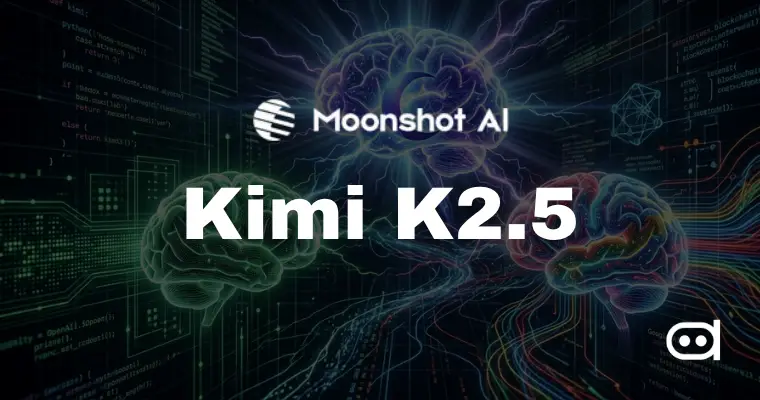
With new organizations challenging existing market leaders, global competition surrounding artificial intelligence has heavily intensified. The most popular new entry into the market is Kimi K2, which Moonshot AI has developed as a powerful new model. It has created significant interest in the emerging market of new AI language models because it competes with advanced systems developed by OpenAI and Google, with scalability and accessibility features that help make it a leading solution.
What Is Kimi K2.5 and Who Created It?
The Chinese artificial intelligence startup Moonshot AI created Kimi K2.5 as a language model development platform. The company has been actively working on competitive alternatives to Western AI systems, and this latest release reflects that ambition. The Kimi K2.5 open source system extends Kimi K2 through an additional 15T visual and text tokens. The system K2.5 functions as a native multimodal model that provides advanced coding and vision capabilities together with a self-directed agent swarm system.
The Kimi AI model enables users to control up to 100 sub-agents for executing multiple processes, which can handle 1500 tool operations simultaneously. The system achieves performance improvements of 4.5 times faster than working with just one agent. Kimi K2.5 generates and manages its agent swarm system without using any previously established agents or operational procedures.
Users can access Kimi K2.5 through Kimi.com, Kimi App, API, and Kimi Code. Kimi.com & Kimi App now support 4 modes: K2.5 Instant, K2.5 Thinking, K2.5 Agent, and K2.5 Agent Swarm (Beta). Free credits for Agent Swarm are currently available to users who have opted for the high-tier paid membership. This alternative to OpenAI vs Kimi AI has achieved increasing user adoption because it creates a framework where multiple AI systems can operate together while competing with each other in complete market diversity.
Key Features That Make Kimi K2.5 Stand Out
Kimi K2.5 features are designed to compete directly with top-tier models. Here are the standout capabilities:
- The Native Multimodal Agentic Model uses 15 trillion tokens to achieve advanced visual-language reasoning, which enables it to interpret visual content, generate operational code, and user interface designs.
- The K2.5 system allots intricate work into separate components, allowing multiple “sub-agents” to execute tasks simultaneously, enhancing efficiency for extended-duration tasks.
- The Kimi AI model performs well in front-end development because it can recreate entire websites from screenshots and videos while using visual elements to find errors.
- The model processes input 23% faster than its previous version because its design changes enable it to maintain extensive contextual understanding.
- The system provides users with instant access to deep-thinking modes, which they can select based on their processing speed versus task accuracy needs.
- It includes web search, code execution, and file processing functions, which enable users to conduct complete independent research and programming activities.
Kimi K2.5 vs OpenAI GPT vs Google Gemini
The Kimi K2.5 vs GPT-4 and Kimi K2.5 vs Gemini AI highlights how the model performs differently in specialized fields according to its performance capabilities.
| Feature | Kimi K2.5 | GPT-4 / GPT Models | Gemini |
| Developer | Moonshot AI | OpenAI | |
| Model Type | Large Language Model | Large Language Model | Multimodal AI Model |
| Parameters | Not fully disclosed | High (varies by version) | High (varies by version) |
| Architecture | Transformer-based | Transformer-based | Advanced multimodal architecture |
| Context Window | Extended long-context support | High (varies by model) | Very high context handling |
| Multimodal Capabilities | Limited to evolving | Available in advanced versions | Strong multimodal integration |
| Unique Feature | Long-document processing | Ecosystem integration | Native multimodal AI |
| Training Data | Large-scale datasets | Diverse global datasets | Google-scale datasets |
| Use Cases | Research, coding, chat | General AI, enterprise | Search, productivity, media |
| Pricing | Competitive / emerging | Premium tiers | Integrated with Google services |
| Best Use For | Long-form reasoning | Broad applications | Multimodal tasks |
| What You Can Do | Analyze, generate, code | Create, automate, assist | Search, create, interact |
Why Kimi K2.5 Is Gaining Attention in the AI Industry
The growing popularity of Kimi K2.5 shows how quickly Chinese AI startups, including Moonshot AI, have developed into global competitors. The demonstration of competitive innovation creates new possibilities that AI models can accomplish.
The demand for advanced AI technology has increased in multiple sectors, such as enterprise automation and content production. The Kimi K2.5 AI model can handle this requirement because it delivers better operational efficiency and system capacity.
The global AI competition has reached a new level of intensity. New companies like Moonshot AI are bringing fresh ideas to the artificial intelligence field while OpenAI and Google maintain their leadership position.
Potential Use Cases of Kimi K2.5
The Kimi AI capabilities provide organizations with multiple ways to utilize them across different business segments. The use cases demonstrate how the Kimi K2.5 AI model can assist both individual users and big organizations.
- Software Development: The system can generate, debug, and reason about code that it extracts from mixed media prompts because it understands both natural language and visual elements.
- Content Creation: Writers and creators can generate complex documents or presentations from minimal input, integrating text with visual references.
- Research and Analysis: The system uses its extensive memory capacity and advanced reasoning abilities to summarize academic or technical content and discover insights from extensive data collections.
- Enterprise Automation: It allows teams to use agent orchestrations for automated execution of multi-component processes, like data ingestion, report creation, and task order management.
Challenges Kimi K2.5 May Face in the Global Market
Despite its strengths, Kimi K2.5 faces several challenges:
- Competition from established players like OpenAI and Google
- Regulatory and geopolitical concerns impact worldwide technology adoption
- The company has low brand awareness when compared to major AI firms
- Moonshot AI faces challenges because people doubt its transparency and the origins of its training data
- The platform needs to develop its infrastructure capabilities to support worldwide operations.
What the Future Holds for AI Competition
The introduction of the Kimi K2.5 model shows that artificial intelligence development has entered a new stage. Worldwide competition now includes startups, technology corporations, and research institutions. The development of AI language models leads to faster innovations, improved performance, and the development of specific abilities. The AI technology improvements that OpenAI and Google, plus emerging companies such as Moonshot AI, develop will create advantages for users through their competitive rivalry.
Final Thoughts
The Kimi K2.5 system marks a crucial advancement in the development of new AI language models. The system achieves strong performance through its long-context abilities, which create a competitive advantage in the worldwide AI market. The ongoing competition between OpenAI vs Kimi AI, and other organizations will create new innovations in the field. The tech industry will benefit from this development because it provides enhanced AI capabilities to developers, businesses, and technology fans. The Kimi K2.5 AI model serves as a major entry in the market because it establishes a new standard for AI development, which will create more international competition and evolving AI capabilities.