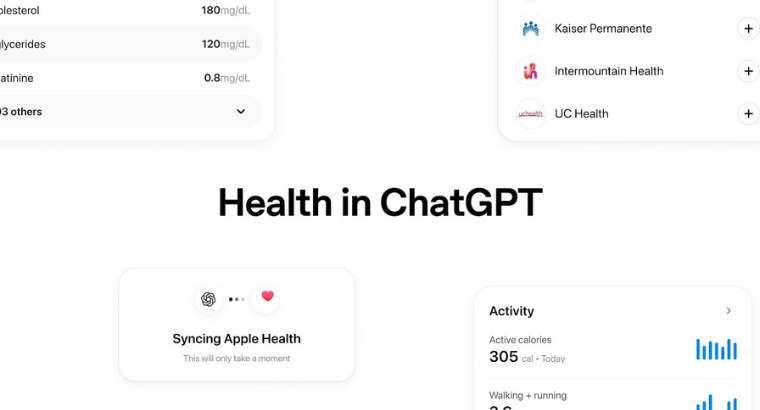
OpenAI began rolling out Health in ChatGPT on July 23, letting users in the United States connect medical records and Apple Health data so the assistant can answer questions using their own information. Access covers logged-in users aged 18 and over on web and iOS, across the Free, Go, Plus, and Pro plans. However, the feature is not yet available in Codex.
The company puts the demand at more than 300 million people each week bringing health questions to ChatGPT, covering lab results, appointment preparation, and making sense of what a doctor said. OpenAI argues the context behind those questions sits scattered across patient portals, records, apps, and wearables, which makes the full picture hard to assemble.
What Health in ChatGPT Connects and How It Works
Users can connect Apple Health, supported medical records from U.S. hospital systems, One Medical, or Function Health. Once synced, ChatGPT can compare a new result against earlier tests, summarise what has changed since a previous appointment, or look at how sleep and activity relate to a routine. Although users can still ask questions without having to connect anything.
The design changed based on how people were already using it. OpenAI introduced a dedicated health space to a limited group earlier this year, and found that more than 70 percent of health-related conversations happened outside it. Rather than requiring users to start in that space, connected information can now surface anywhere in ChatGPT. The company gives the example of the assistant accounting for a dietary restriction while helping choose a restaurant, or a recent injury when planning a weekend activity.
We built this experience based on feedback from early testers and physicians.
— OpenAI (@OpenAI) July 23, 2026
With your permission, ChatGPT can use relevant context you’ve connected in Health across your conversations — to help you compare a new result with prior tests, summarize changes since your last… pic.twitter.com/joWXUxjQjO
By default, ChatGPT asks permission before drawing on connected records, and users can approve each request or switch the prompts off entirely. Adding @Health to a message invokes the context explicitly. The Health section in the sidebar remains where accounts, synced records, and past health conversations are managed.
What OpenAI Says About Privacy and Data Retention
The privacy terms are more restrictive than OpenAI’s defaults elsewhere. Connected medical records and Apple Health information, along with conversations that use them, are not used to train the company’s foundation models or to target ads, and that holds regardless of the model-training setting a user has chosen. Conversations in Health receive encryption protections beyond the standard applied to all ChatGPT chats.
Disconnecting an account deletes the synced data from OpenAI’s systems within 30 days. An important note here is that whatever information already surfaced inside a conversation stays in that chat history until the user deletes the conversation itself. Therefore, disconnecting a source does not clear what has already been discussed.
Memory works on a similar split. Memories can be generated from health conversations, though OpenAI says they are not created directly from connected records. The company also describes safeguards that check before ChatGPT takes an action in another connected plugin that could disclose health data, with confirmation prompts on some sensitive actions.
How OpenAI Measured GPT-5.6 Sol on Health Questions
Model performance is where the claims rest on OpenAI’s own testing. GPT-5.5 Instant handles health conversations on the free tier, while GPT-5.6 Sol is available to paying users and is described by the company as its strongest model for health work. OpenAI says every GPT-5.6 model outperformed GPT-5.5 on HealthBench Professional, an evaluation of performance on difficult health tasks.
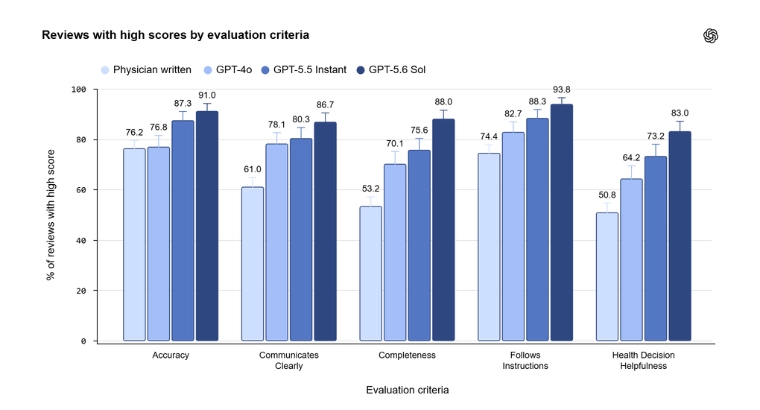
That benchmark is OpenAI’s own, publishedOpenAI by the company, which places the scoring and the model under the same roof. The evaluation process draws on hundreds of physicians developing scenarios and rubrics covering accuracy, safety, communication, context awareness, completeness, and escalation. OpenAI states plainly that ChatGPT can still make mistakes and does not replace the judgement of qualified medical professionals, and encourages users to verify important information with their provider.
The gap worth watching is independent verification. No outside body has yet audited how the system performs when reasoning over a real person’s connected records, which is a different task from answering a health question in isolation.
You may also like to read – ChatGPT Version Timeline: How the OpenAI Models Got Smarter Over the Years