Key Highlights:
- Jetson AI devices embed JetPack 7.2 with an increase in real-world AI with secure deployment.
- The announcement introduces Yocto project support and multi-instance GPU on Jetson Thor for control and efficiency.
- With an inbuilt Nemo cloud support, the 7.2 version decreases the complexities for edge AI developers.
As AI agents step into the physical realm, such as ARs, industrial systems, cameras, and robots, the need for hardware and software platforms increases. Developers need systems that can facilitate AI agents locally, manage huge workloads, and meet the desired requirements. To power this change, NVIDIA launched JetPack 7.2, a recent software update in the SDK platform. It focuses on preparing devices for real-world AI by improving the system and providing greater autonomy to developers for optimization. By procuring a blend of AI agents, streamlining workflows, and in-depth systems, the change places Jetson to build real-world AI.
What Is NVIDIA’s JetPack 7.2?
NVIDIA JetPack is the comprehensive software development kit (SDK) for the NVIDIA Jetson platform, designed to build and deploy AI applications, robotics, and edge computing systems. Jetpack 7.2 update for the Jetson AI platform is launched to push AI workloads directly on-device. As the physical AI structures possess more complexity, one Jetson device needs more control, generative AI, and security. Considering this change, the new update extended NVIDIA’s compute stack and agentic capabilities across Jetson platforms, including Jetson Orin and Jetson Thor.
The software-centric nature reflects that the hardware continues to develop, with each software release helping the developers extract more information without constant changes, without changing the devices.
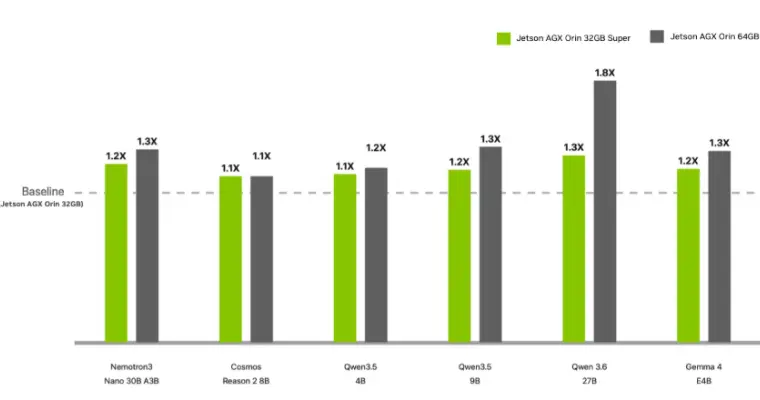
According to NVIDIA, the launch also promises better prices and performance through features such as super mode for Jetson AGX Orin 32GB, allowing it to deliver high-quality performance and reduce costs. These changes help increase, help push the development, provide better performances, and reduce the overall prices.
How JetPack 7.2 Inculcates NemoClaw in its Functioning?
One of the most crucial aspects in JetPack 7.2 is the onset of NemoClone. NemoClone refers to an open-source framework that adds safety and privacy to AI agents, making it ideal for physical AI deployments. With version 7.2, the required software stacks are pre-configured and allow the developers to deploy NemoClone workflows with one command.
This decreases the need for human deterrence and allows and streamlines agentic applications for robots and industrial work. JetPack 7.2 also contains NVIDIA agentic skills for Jetson, which allows the agent to automate simpler tasks.
These include covering Jetson Linux customization and memory optimization. Tasks that require multiple commands and huge timelines, such as configuration and optimization, or selecting the most efficient AI model, are built by the AI agents. This reduces the burden and streamlines the path to production.
Why do MIG and Yocto Project Matter?
JetPack 7.2 includes multi-instance GPU infrastructure on Jetson Orin, bringing data-centric GPU partitioning to the AI systems. This system allows the embedded NVIDIA Blackwell GPU to be divided into two isolated GPUs, each with fixed compute and memory bandwidth.
This is crucial for systems where time-sensitive work, such as robotics or safety monitoring, must run parallel to generative AI. By severing the workload, a multi-instance GPU helps ensure better performance and less interference, which is necessary for physical AI systems.
The declaration also introduces support from the Yocto project and helps developers to create custom Linux distributions for Jetson. Yocto allows stern control over memory, safety, and system size, including those components required for the application. It also provides generative builds, which are salient for certification, lengthy maintenance, and debugging in the industries.
Altogether, the Yocto project and MIG help developers aim for autonomy, efficiency, and dependency for deployment.
JetPack 7.2 for Jetson AI devices is the cornerstone for the upcoming AI where agents work in the physical world and meet the criteria of security and reliability. By allowing these AI agents to function without any extra setup and adding additional support from MIG and Octo Project, NVIDIA is reducing the complexities for developers. JetPack 7.2 provides a flexible base assisting teams to move from prototype to production with better value.