Key Highlights:
- Google says Gemini, Gemini Notebook and Search will be turned off by default for K-12 student accounts, allowing school administrators to enable services individually.
- Guided Learning is being introduced in Google Search and Classroom to encourage students to solve problems step by step instead of relying on AI-generated answers.
- Google has clarified that schools choosing not to enable AI will also lose access to Search, raising questions about whether its new AI controls offer genuine choice or create a difficult trade-off.
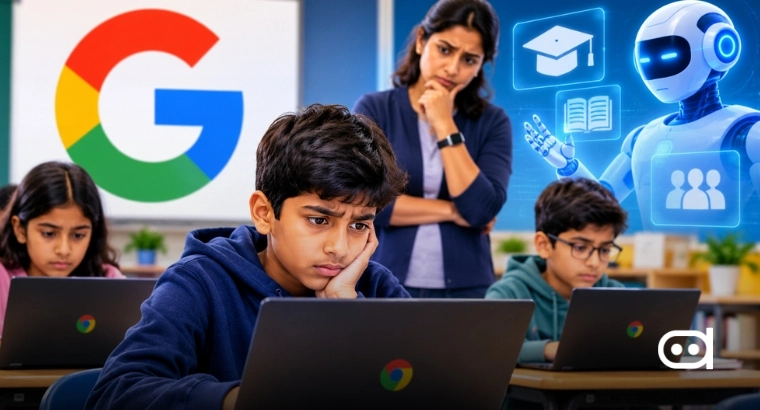
Google’s newest changes to its education products are intended to give schools better autonomy over how students use artificial intelligence. The announcement has garnered debate over what the control actually means. On November 3, the company said AI services would be switched off by default for K-12 student accounts, with administrators able to decide which features to enable.
However, a simultaneous clarification revealed that schools opting out of AI would also lose access to Google Search because the two services are embedded together. The decision comes as educators continue to express concerns about students using AI to shortcut schoolwork rather than develop independent problem-solving skills.
What Has Google Announced About AI Controls and Why Are Schools Questioning Them?
Google initially presented the changes as a move towards giving schools autonomy in managing AI control. Under the updated approach, Gemini, Gemini Notebook, Gemini in Classroom, and Google Search will be unavailable by default for K-12 student accounts until school administrators explicitly enable them. The company said administrators would be able to choose which services to activate, rather than accept or deny Google’s entire collection of AI products. The announcement followed feedback from schools, teachers, researchers, policymakers seeking autonomy over how students interact with generative AI.
However, the explanation attracted further attention after Google clarified how its new controls would affect access to Search. In a statement to the New York Times, Google Education Vice President Chris Phillips explained that AI and Google Search were deeply integrated. If a school decided not to enable AI, students would not have access to Search either and would instead see a message indicating that the service was unavailable.
This clarification has become the focal point of contention surrounding the announcement. While Google initially emphasized that administrators could independently enable or disable services, the Search restriction means schools cannot simply retain conventional Google Search while blocking its AI features. The distinction puts forward questions about whether Google’s approach genuinely expands institutional choice or creates a more difficult decision for schools that want to limit AI without giving up an established Search tool.
Google has clarified that Gemini, Gemini Notebook, and Search will be off by default for K–12 student accounts. Schools will be able to enable each service individually. Google is also adding Guided Learning to Search’s AI features, designed to walk students through homework problems step by step. The Search pilot starts in selected US schools in November. Google will provide more details before the new account controls roll out.
— Wes Roth (@WesRoth) November 4, 2026
Google plans to begin piloting these Search capabilities in select US schools later in November, gathering feedback from educators before expanding to extra school districts in the coming months. However, the approach does not eliminate the probability of students using AI to complete their assignments. Google acknowledges that its generative AI products can make mistakes, and the availability of guided prompts does not necessarily prevent students from asking for more direct answers or full essays.
How Could Google’s New AI Control Change the Classroom Experience?
Alongside Search, Google is bringing Guided Learning to Classroom, where the feature is already globally available. It is designed to work as a one-on-one study tool that uses class materials to help students remain focused on assigned topics.The feature also provides teachers with real-time insights into students’ learning activities, helping them identify areas where individuals or the wider class may need additional support.
Google said it worked with schools and educators before introducing Guided Learning in Classroom, incorporating feedback from teachers who tested the feature. However, the broader debate is not restricted to whether Guided Learning can improve classroom experiences. It also concerns how much influence a technology firm should have over the instruments school can access when deciding their AI policies.
Google’s approach appears to depend on the expectation that schools will want to retain search and may therefore choose to enable AI services rather than lose access to the platform. This could expose students to artificial intelligence tools more frequently, potentially changing how they search for context and complete school work. Ultimately, the question is whether guided learning can reduce students’ tendency to use AI as a shortcut, or simply offer a more education-focused version of the same technology. And if schools cannot separate AI from Google Search, how much choice do they really have?
Also Read: 12 Best AI Tools for Teachers in 2026 to Save Time & Boost Learning