- Anthropic just announced that its latest Claude models can now tackle advanced chemistry work. These models analyze Nuclear Magnetic Resonance (NMR) spectra and figure out molecular structures.
- In tests, Claude Opus 4.7 outperformed its rivals at predicting hydrogen NMR results and kept up with some of the best chemistry software out there like MestReNova when it came to carbon NMR. The researchers put it through its paces with 20 compounds and 15 trickier “inverse-structure” challenges.
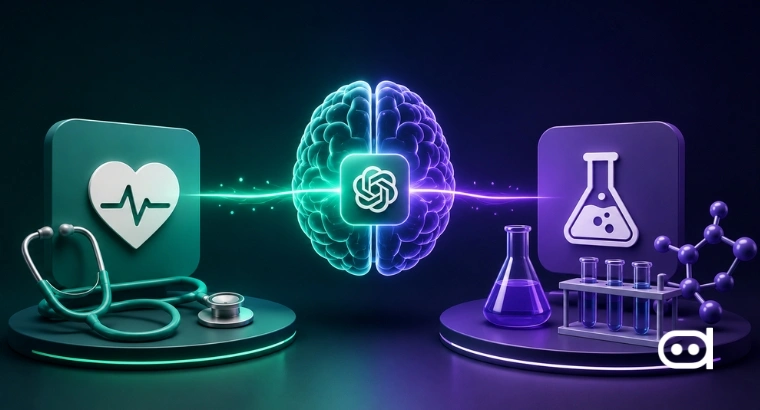
- You can see the same shift that already happened in healthcare, where ChatGPT grew from an all-purpose chatbot to a popular tool for making sense of medical information.
When ChatGPT first entered the mainstream, its appeal was mainly tied to its ability to answer questions and generate human-like text. But over time, the real breakthrough was how it became a health assistant for millions of people. People started relying on AI to understand symptoms, decode lab reports, summarize medical studies, and navigate complex healthcare terminology.
Anthropic showed that Claude, which started as a general-purpose language model, can now tackle complex chemistry tasks, a world that used to belong strictly to specialist software and researchers with years of training. What matters more is what this says about where AI’s going: it’s not just about building smarter chatbots anymore, it’s about building real experts for specific professional fields.
How Anthropic’s Claude Chemist Shifts Focus Onto Scientific Expertise
Anthropic’s latest work focuses on Nuclear Magnetic Resonance (NMR), a fundamental technique used by chemists to determine the structure and composition of molecules. NMR is critical in everything from pharmaceuticals to materials science to basic academic research, but making sense of NMR data takes serious expertise and usually dedicated software.
So they put Claude to the test. First, by having it predict NMR spectra from known molecular structures. Then, by flipping the problem and asking the model to figure out molecule structures from the spectra and formulas.
Claude did well. On hydrogen NMR, Claude Opus 4.7 was the best performer. For carbon NMR, it held its own against MestReNova. The study looked at 20 compounds when predicting spectra and 15 inverse-structure problems. And what really stands out is that Claude wasn’t built just for chemistry. It was up against tools like ChemDraw and MestReNova, both designed specifically to solve those chemistry problems.
Anthropic thinks this could be a big deal. Instead of being a single-use calculator, Claude can help researchers move between molecular structures, spectra, papers, lab notes, and all sorts of chemical notations. In other words, they imagine an AI assistant that can connect multiple forms of scientific knowledge within a single workflow.
New Anthropic Science Blog: Making Claude a chemist.
— Anthropic (@AnthropicAI) June 5, 2026
To manipulate a molecule, chemists first need to understand its structure. Their main tool is NMR spectroscopy.
We found Opus 4.7 matches—and on some tasks beats—dedicated NMR software. Read more: https://t.co/1jUvz7wdhV
ChatGPT Health, Claude Chemistry – How AI “Specialist” Are on The Rise
ChatGPT was not a platform for medicine at first. Still, because it could process data and explain complicated concepts fast, people started using it for health patients and professionals. People use it to figure out diagnosis, medicines, research articles, and lab results. Doctors have even experimented with it to summarize and retrieve information.
Claude’s chemistry breakthrough follows a remarkably similar path. Like ChatGPT, Claude started as a language model for all sorts of uses. Now it’s moving into a technical area that used to need specialized tools.
In both cases, the value lies less in raw computation and more in interpretation. ChatGPT helps bridge the gap between dense medical information and human understanding. Claude appears to be doing something similar for chemistry by connecting molecular structures, NMR spectra, formulas, and scientific literature.
All of this says a lot about where AI is moving. At first, companies competed over whose chatbot sounded more human or answered basic questions. Now it’s about building models that can actually act like experts in chemistry, medicine, law, finance, and scientific research.
Of course, there are limits. Just like ChatGPT can’t replace doctors, Claude’s not about to replace chemists either. Medical choices still need trained professionals and the same goes for scientific conclusions.
Also read: OpenAI Moves into Healthcare with New ChatGPT Health; Here’s What We Know So Far
Anthropic’s “Claude the Chemist” research isn’t just about NMR or molecule sketches. It marks the next stage in how these AI models are changing. What started with ChatGPT as a medical assistant is happening again, AI is evolving from basic conversation to domain expertise. If ChatGPT helped people make sense of health information, Claude is starting to help chemists with complex technical analysis.