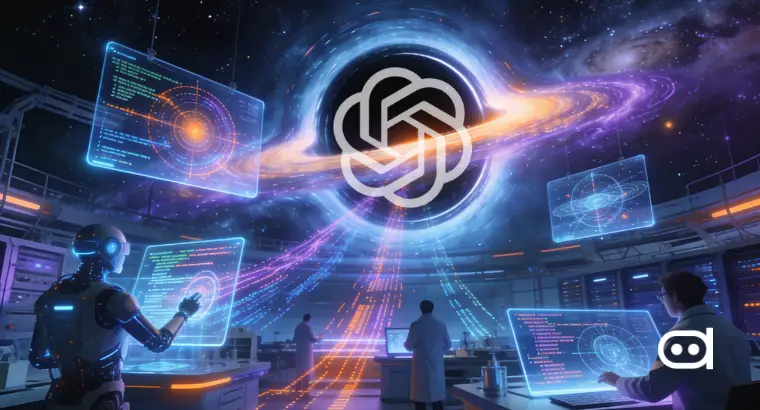
Modern technology has given us powerful telescopes, but they aren’t enough to reveal everything about the universe’s secrets, including black holes. Scientists rely heavily on computer simulations to recreate how particles, magnetic fields, and plasma act in some of the universe’s most extreme environments. But those simulations become so complex that even the most powerful computers struggle to keep up.
OpenAI’s recent case study shows scientists are turning to Codex to tackle these hurdles. Geoffrey Chan leads the effort and believes AI gives them a shot at covering more computational ground in less time. It’s not about discovering new physics, but it’s about helping researchers test methods that could significantly improve future simulations.
The Computational Challenge behind Black Hole Physics
Supermassive black holes are almost impossible to model. Researchers have to account for charged particles zooming through strong magnetic fields, interacting under vicious conditions. The hardest part is tracking electrons and ions moving at crazy speeds around magnetic field lines. Simulations have to follow a vast number of tiny movements, so computers burn through time calculating particle behavior.
And around these black holes, some regions are filled with particles that hardly ever collide. Usually, scientists can treat matter as a fluid and simplify their calculations, but not here. Near black holes, those shortcuts don’t always work, forcing researchers to model single particles, which increases the computational workload.
That’s why finding ways to run these simulations faster is an urgent goal. Better algorithms could let scientists study conditions that are currently impossible to analyze. According to OpenAI, if these advances happen, researchers could simulate trillions of particles, opening up new frontiers in astrophysics.
How OpenAI’s Codex is Helping Scientists Study Black Holes Faster
Chan’s approach is pretty straightforward: he uses Codex to brainstorm computational solutions. Instead of manually testing every single numerical trick, Codex gives out possible algorithms and coding strategies that could reduce the workload.
The process is highly experimental. Codex proposes ideas, researchers evaluate them and only the most promising approaches move forward. Many suggestions fail to meet scientific requirements, but that is an expected part of the research process. In science, progress often comes from testing numerous possibilities before identifying one that works.
Codex doesn’t replace expertise. It provides a way to simulate more possibilities and accelerate the whole process of experimenting, evaluating, and repeating. The article further stresses the fact that it doesn’t matter where an idea comes from: Codex, a student, or a scientist; every proposal gets tested against real results. The scientific method stays the same, even when AI becomes part of the process.
Transparency is another key aspect of the project. Researchers can inspect, understand, and verify the outputs produced by Codex. Rather than delivering unexplained answers, Codex contributes suggestions that scientists can analyze and refine before determining whether they have practical value. Not only does this add more clarity to the process, but it also makes follow-ups easier based on the availability of the generated data.
For Chan, the appeal of Codex lies in its ability to accelerate exploration. The quicker researchers can test ideas, the more chances they have to find new ways to change how black hole simulations work.
Also read: Scientists Stimulated a Fruit Fly’s Brain Inside an AI System and Succeeded; Are Human Brains Next?
OpenAI’s case study is an example of AI helping scientific research without replacing humans. Faced with massive computational demands, researchers use Codex to try new algorithms and coding tricks that could make these simulations much faster. Every idea from Codex still needs tough testing and verification. But it lets scientists try more possibilities in less time.