Sakana AI rolled out Fugu Ultra v1.1, the latest version of its multi agent AI platform built for complex reasoning, coding, and research. Instead of building a whole new system, the team focused on updating the frontier models inside the platform. The architecture, API, and pricing all stay exactly the same. The goal is to improve performance without requiring developers to change the way they use the service.
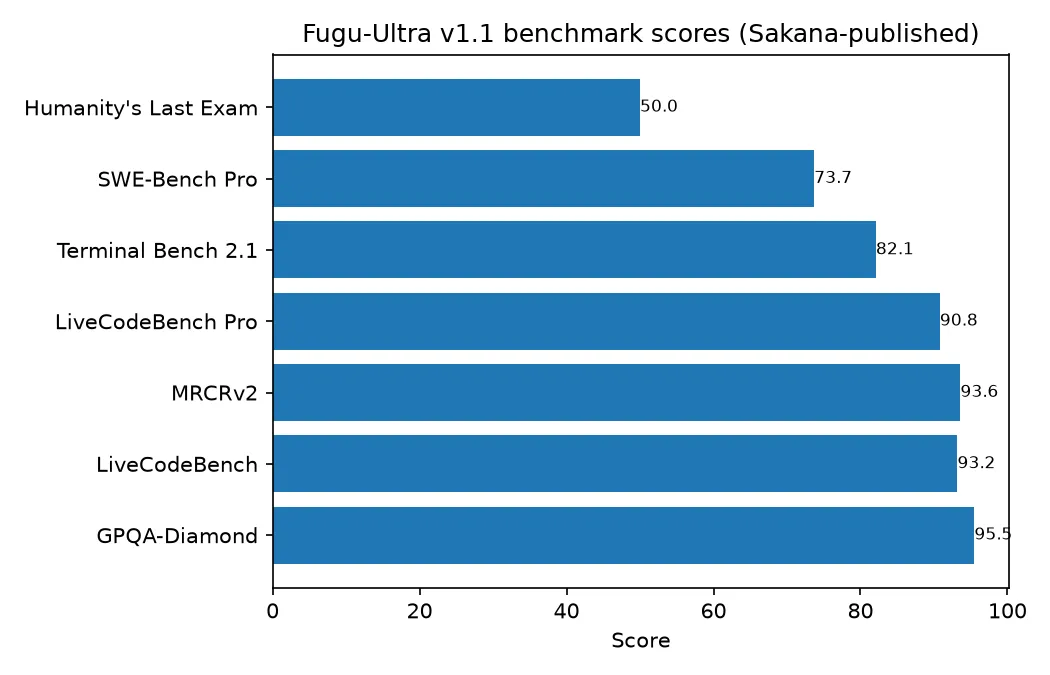
The company claims Fugu Ultra v1.1 pushes performance up by as much as 7.9 points on their internal benchmarks compared to version v1.0, citing Sakana AI Labs. They say this gain comes from replacing older frontier models with newer ones in their orchestration system. But when you look at their public benchmark tables, you would not see separate scores for v1.0 and v1.1, that means nobody outside the company can actually double check these gains with published data right now.
How Fugu Ultra v1.1’s Multi-Agent System Works
Fugu Ultra v1.1 is not just a single large language model. Instead, it is a multi agent orchestration system that coordinates several frontier AI models to solve each task. So instead of sending every request to one model, the platform splits the work between different agents and then combines their output into a final answer.
Each agent has a clear role. Some build a plan. Others generate the answer. Some review or double check the output for accuracy. This setup is there to boost the quality, especially for tasks that require several reasoning steps or more advanced thinking. Unlike a major redesign, the v1.1 update focuses on refreshing the models used inside the orchestration system. Sakana AI says replacing the underlying frontier models has helped improve overall performance while allowing users to continue using the platform in the same way as before.
Announcing Fugu-Ultra v1.1 🐡
— Sakana AI (@SakanaAILabs) July 24, 2026
We’ve been thrilled by the reception to the Fugu model family. Thanks to everyone who tried it, shared feedback, and trusted Fugu with real work.
Today, we’re releasing Fugu-Ultra v1.1 → https://t.co/aDEFyySWlS
Upgraded to incorporate the latest… pic.twitter.com/AwtLwq67on
What Sakana AI Changed, and What the Benchmarks Don’t Show
Sakana AI says the performance in picture improvement comes from updating the pool of frontier models used by the platform. However, while the company has shared the benchmark gain, the available benchmark tables do not provide separate results for v1.0 and v1.1. As a result, the published information does not allow a separate comparison between the two versions.
- Uses a multi agent orchestration system instead of a single AI model.
- Assigns different roles such as planner, worker, verifier, and reviewer.
- Coordinates multiple frontier AI models to produce the final response.
- Designed for complex coding, reasoning, and research tasks.
- Supports an OpenAI compatible API.
- Updates the underlying frontier models while keeping the same architecture.
- Claims up to a 7.9 point benchmark improvement over Fugu Ultra v1.0.
This platform targets users who need help with harder reasoning, coding, or research, this is not for everyday conversations. The whole idea is that multiple agents working together may provide stronger results than relying on a single model. A big selling point is the OpenAI compatible API. Developers can hook Fugu Ultra right into their existing projects without having to learn everything from scratch. Apps already built on OpenAI’s APIs can just keep working with minimal tweaks. Sakana AI also emphasizes that Fugu Ultra reduces reliance on any one AI provider. Instead of trusting a single frontier model, the system combines the strengths of multiple models through its orchestration layer.
The updated release is available as Fugu Ultra v1.1 and it continues to use the same pricing as the previous version.
| $5/M input tokens $30/M output tokens Higher rates apply for contexts larger than 272K tokens. |
With Fugu Ultra v1.1, Sakana AI has chosen to improve the intelligence of its existing multi agent platform rather than introduce a new architecture. The new update upgrades the models inside the planner, worker, verifier, and reviewer agents but everything else, including the API, the pricing, and the overall user experience, stays just as it was.
Also read: Sakana AI Claims its ‘Fugu Ultra’ Matches the Performance of Claude’s Fable and Mythos