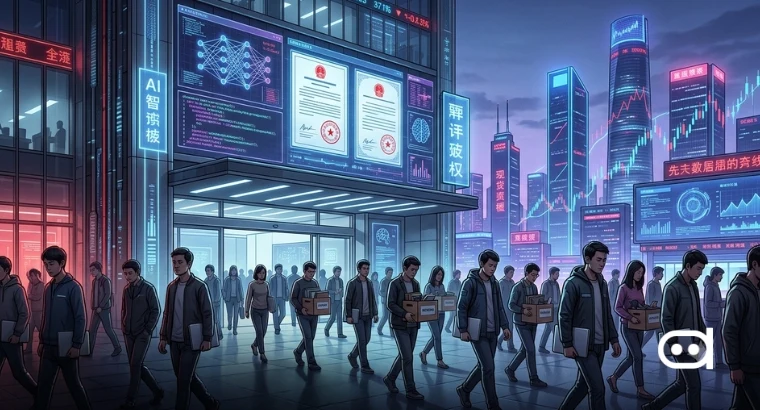
- Chinese organizations are reducing contractors and slowing down the hiring process as AI deployment accelerates.
- Labor laws and political sensitivities shape AI adoption, supporting slow cuts over large layoffs.
- Employees fear that Artificial Intelligence deployment replaces workloads, even as organizations avoid obvious job losses that could trigger inspection.
As the nation asks the conglomerates to adopt artificial intelligence to boost productivity, Chinese firms practice slow layoffs to balance efficiency with political regulations. Rather than massive layoffs, employers are reducing contractor roles and relying on slow hiring to be in the government’s good books. Interviews with employees across technology, advertising, and entertainment niches show that a surge in artificial intelligence adoption is already being practiced. Companies are trying to avoid attention that could threaten their reputation or social stability. It also takes a toll on employees facing job security threats.
Who Is Being Affected by China’s Silent Layoffs?
A statement given by Liu, a 26-year-old contractor, states that a massive Chinese firm began silently firing contractors in March. This measure was taken to push artificial intelligence deployment. The company has also taken steps to reduce hiring across the niches.
Liu also said that the tasks most people perform cannot be completely replaced, explaining that once the workflows are embedded into artificial intelligence systems, the employees can be fired.

What Drives the Organizations to Do So?
Chinese organization faces a different setback while companies around the world want to exercise a rise in artificial intelligence deployment. Beijing wants artificial intelligence deployed to transform productivity, but in a way that the layoffs are not visible. Under Chinese labor laws, companies must wait for government approval for job cuts exceeding 10% of their total workforce.
The Chinese judicial system also have also ruled against organizations in at least three cases for removing workers as artificial intelligence replacements. Due to this, companies are choosing slow layoffs, which highly contrasts to the West, where major firms have announced large job cuts.
A large Chinese fintech company’s senior manager stated that private firms will depict management inefficiencies to avoid a layoff that could lead to political instability. The persons that are restructuring is at peak with every major technology firm in the country, and front-end roles are highly affected by artificial intelligence adoption. An engineer at Alibaba’s cloud division also quoted that AI-centric reductions are starting in various niches and will unfold slowly through gradual cuts rather than one single layoff. Rather than removing a large number of staff, companies are reducing contractors, reducing new hires, and reshaping entire teams as artificial intelligence adoption grows.
Why Is AI Adoption Accelerating Regardless of Job Concerns?
Experts in the field say that Chinese firms are committed to accelerate artificial intelligence adoption. He Shuijing, a senior expert at Plenum Consultancy, said that companies are all in for AI deployment. The efficiencies from artificial intelligence will reduce hiring, but large firms are expected to be cautious about direct workforce cuts.
Some firms inculcate gradual layoffs as a performance metric. Employee use of tokens, which is a unit for measuring AI compute, is being tracked to calculate efficiency. Moreover, workers note that higher token use does not mean better efficiency or output.
China’s AI-centric gradual layoffs reflect an app that prioritizes artificial intelligence deployment and its subsequent efficiency. Companies aim to deploy artificial intelligence aggressively to stay at the top of the realm, yet are restricted by labor regulations and political instability that discourage job losses. Through this, the result is a way of restructuring where the layoffs are gradual as artificial intelligence tools continue to replace workflows and intensify the gap between productivity and employment stability. It will push policymakers to confront artificial intelligence automation.