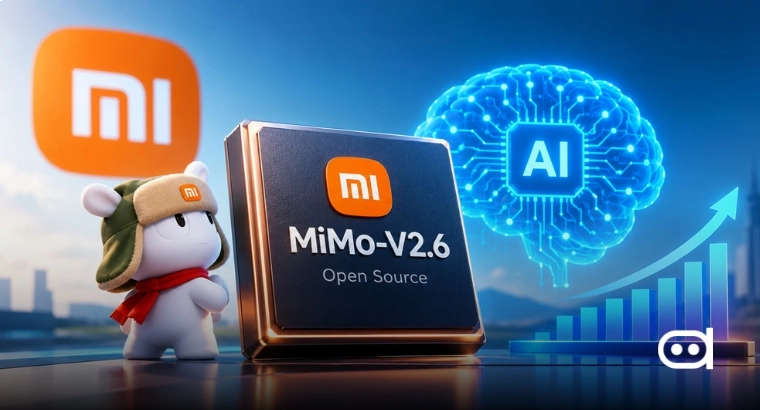
Xiaomi has announced the release and open-sourcing of its MiMo-V2.6 series. It is led by MiMo V2.6-Pro, whose Artificial Analysis score is at 46 on its Intelligence Index, placing it first among open-source models on the leaderboard. The series includes two natively omnimodal models, MiMo-V2.6-Pro and MiMo-V2.6-Flash, alongside a Pro-UltraSpeed variant created for swift generation. Xiaomi is also releasing model weights, its technical report, training environments and reinforcement-learning code. This will give researchers access to the work behind the models. The release comes with a 1 million-token context window, sparse mixture-of-experts architecture and support for text, image, video and audio inputs.
How Does Xiaomi’s MiMo-V2.6 Compare with other AI Models?
Artificial Analysis records MiMo-V2.6-Pro at 46 on Intelligence Index v4.3.2, a composite benchmark covering 10 evaluations, including AA-Briefcase, GDPval-AA, AutomationBench-AA, Terminal-Bench, SciCode and Humanity’s Last Exam. Its open- source comparison places MiMo-V2.6-Pro ahead of Z AI’s GLM-5.3 (max) at 45 and Kimi K3 (max) at 44. Artificial Analysis also enlists Grok 4.7 (xhigh) at the same score of 46 among proprietary systems. Xiaomi cites a 46.32 score and describes MiMo-V2.6-Pro as the strongest open-source model to date. It says it surpasses Kimi K3 and Qwen 3.8 Max.
What Is Inside Xiaomi MiMo-V2.6-Pro’s 1.02 Trillion Parameters?
The flagship MiMo-V2.6-Pro-RL checkpoint is a sparse mixture-of-experts model with 1.02 trillion total parameters, of which 42 billion are activated per token. It supports a 1-million token context window and accepts text, image, video and audio inputs while producing text output.
Introducing Xiaomi MiMo-V2.6 — Pro & Flash.
— Xiaomi MiMo (@XiaomiMiMo) September 21, 2026
Frontier intelligence, all the modalities, built in public.
🔹 Two omnimodal models, advancing through scaled reinforcement learning
🔹 Pro performs on par with Claude Opus 5 and GPT-5.6 Sol across most agent benchmarks
🔹 Pro scores… pic.twitter.com/oqfYPC00uK
The model uses a 70-layer backbone with 60-sliding window attention layers and 10 global-attention layers. Its architecture contains 384 routed experts, with eight active for each token. Xiaomi’s multimodal components include a 681-million-parameter MiMo ViT for vision. It also has a 308-million-parameter AudioTokenizer and a 127-million-parameter audio patch encoder for audio processing.
The model also uses a five-layer multi-token-prediction speculative decoder capable of predicting seven subsequent tokens per forward pass. Artificial Analysis records the model under an MIT license, allowing commercial use. Xiaomi has published weights for MiMo-V2.6-Pro-RL and MiMo-V2.6-Flash-RL on Hugging Face, with ModelScope availability at launch.
What Xiaomi MiMo-V2.6 Costs Developers Through The MiMo API
Xiaomi says the MiMo-V2.6 series was developed through a large-scale reinforcement learning process that was streamed live in less than six days. MiMo-V2.6-Flash and MiMo-V2.6-Pro each completed 30 RL steps across roughly 750,000 trajectories. Xiaomi reported costs of approximately $850,000 for Flash and $2.62 million for Pro. Average pass rates on training tasks increased by 25% and 12% in relative terms. On the held-out DeepSWE v1.1 software engineering benchmark, Xiaomi reported scores increasing from 48.8 to 65.6 for Flash and from 58.4 to 72.57 for Pro.
/
The company said its scaled RL compute through larger asynchronous batches, training at up to 1.1 million tokens of context and 3.5 billion to 3.7 billion tokens per step, when using coding, general agent, visual, and cyber tasks. It also increased grader compute to generate more precise reward signals.
MiMo-V2.6-Pro scores 71.9 on DeepSWE v1.1 in Xiaomi’s benchmark tables, compared with 67.9 for Flash and 19.0 for MiMo-V2.5-Pro. Xiaomi also reports 76.9 on Toolathlon-verified, 53.1 on Automation Bench v1.0.6, 34.9 on Terminal Bench 4.0 and 94.0 on CyberGym. On CyberGym, Flash scores 95.1 compared with 84.5 for GLM 5.3. Both Pro and Flash are available through AI Studio, MiMo Code and MiMo Desktop, as well as the MiMo API Platform and OpenRouter. MiMo Desktop has also moved out of early access with its first official release.
Xiaomi has kept API pricing unchanged from the V2.5 series. MiMo-V2.6-Pro costs $0.0036 per million tokens for cache-hit input, $0.435 for cache-miss input and $0.87 for output. Flash costs $0.0028, $0.14 and $0.28 respectively, while Pro-UltraSpeed costs $0.036, $4.35 and $8.70. Xiaomi says Pro-UltraSpeed can deliver up to 20 times faster output at the same quality for users prioritizing generation speed.
The company has demonstrated the models across multi-agent game development, Blender 3D modeling, robotic arm-control, frontend and presentation, video creation and music composition. In research demonstrations, MiMo-V2.6-Pro helped design metal-organic framework candidates for PFAs adsorption and produced a more than 6000-line Lean 4 formalization of Li and Yorke’s “Period Three Implies Chaos” theorem, which Xiaomi says was verified by Lean’s kernel without unfinished proof placeholders.