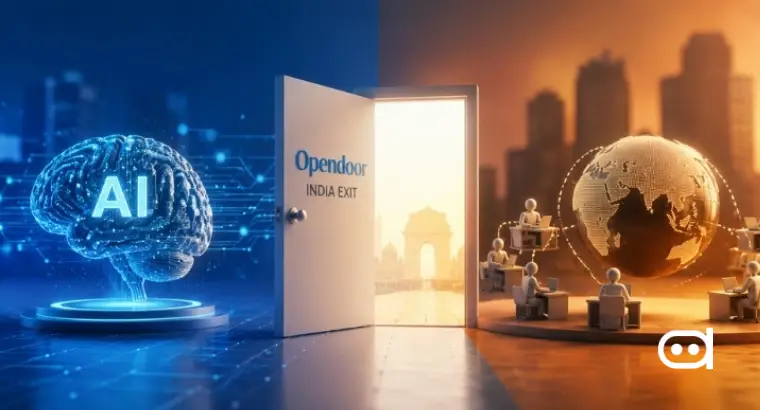
Opendoor’s decision to close its India operations has started a debate that goes way beyond one company’s restructuring. What looked like just another round of layoffs at first quickly turned into a bigger conversation about artificial intelligence and how it might shake up outsourcing, a model that has kept global business running for decades.
The debate gained attention after Opendoor’s leaders mentioned their shift toward smaller AI-native teams as a key reason for the change. The company has previously dealt with wider business hurdles but the announcement got investors, founders, and industry experts to ask whether AI is beginning to alter the economics that made large offshore teams an attractive option for companies around the world.
Why are Companies Building Smaller AI-Powered Teams?
Everyone’s asking, if AI can handle more routine operational work, do companies actually need fewer employees to get the same results? As reported by TechCrunch, Opendoor CEO Kaz Nejatian highlighted their move to smaller AI-native teams, and suddenly that phrase became central to all these discussions. The idea reflects the growing belief among tech leaders that AI can help smaller teams reach productivity levels that once required much larger workforces.
For a long time, businesses grew by simply hiring more people. Bigger operations meant bigger teams. But now, companies are testing out systems that automate repetitive tasks, manage workflows, and reduce manual steps. So, you don’t need to add people every time you decide to expand.
Investors are paying close attention, seeing Opendoor as an early example of how AI could shape future organizational charts. The focus isn’t just on saving money; it’s about making teams more efficient. If AI can handle routine jobs, companies might build smaller, tech-supported teams rather than just keep hiring.
🚨 US-based Opendoor is shutting down its India operations and laying off nearly 250 employees. pic.twitter.com/v8OxBE2f8d
— Indian Tech & Infra (@IndianTechGuide) June 11, 2026
Why Opendoor’s Move has Sparked a Bigger Outsourcing Debate
For decades, companies have relied on offshore operations to reduce costs by moving labor-intensive work to markets with large talent pools. India became a giant in this space, building a huge outsourcing and Global Capability Center ecosystem. According to the numbers shared, the country hosts thousands of centers, employs millions, and generates nearly $100 billion each year from the sector.
Now, some industry observers worry that AI might start taking over tasks that big offshore teams used to handle. Instead of moving jobs from one country to another, companies could just automate them completely. Opendoor’s move doesn’t prove that AI is replacing outsourcing on its own. The company has dealt with bigger challenges tied to the U.S. housing market and has implemented workforce reductions in other parts of its business as well. So it’s tough to say AI alone pushed them out of India.
Experts quoted in the debate see this as maybe the beginning of a larger shift, not a clear turning point. Some mention the rise of Services-as-Software, a model that combines AI, software, and human insight to deliver outcomes without adding more people. Whether this becomes a bigger trend remains uncertain. But the fact that one restructuring decision sparked this much discussion shows companies, investors, and workers are already thinking ahead to a future where AI plays a much bigger part in business.
Also read: AI-Driven Cyber Fraud Poses Growing Threat to Financial Security, Indian Government Warns
Opendoor’s exit from India is now more than just a business restructuring story. It has become a real-life example of how AI is changing conversations about hiring, productivity, and the global workforce. We still don’t know if this is an isolated decision or the beginning of a new trend, but it definitely spotlighted the idea that companies might be able to achieve more with smaller, AI-backed teams.