As artificial intelligence grows, frontier AI systems face a roadblock: how to provide efficient outputs while preventing unauthorized use? The example stems from Anthropic’s latest launch, Claude Fable 5. The announcement stated that sensitive queries will fall back to Claude Opus 4.8, a less advanced system. This indicates a new pattern representing less accessibility rather than denial.
It is a cautious move for frontier AI models, but it also raises a question: If the sensitive query shifts to Claude Opus 4.8 rather than being dismissed, does the risk disappear? The outcome is quintessential as frontier AI systems work in real-world research.
Why Anthropic Limits Claude Fable 5
Anthropic claims that Fable 5 is one of the most secure systems to date. According to them, the model possesses strong reasoning power across niches such as research, coding, and problem-solving.
Similarly, Anthropic understands that such abilities give rise to new issues. The company said that releasing a Frontier AI model requires distinct safeguards because of its expertise in areas such as cybersecurity and extensive research.
To resolve these concerns, Anthropic has embedded safety features that prevent Fable 5 from entertaining sensitive prompts. Instead, these questions fall back to Claude Opus 4.8. The company states that this approach helps users while reducing the chances of misuse. Theoretically, limited access to the strongest model will create an extra protective layer.
Does Routing Queries Reduce Threat?
While AI’s additional safety features seem valid, analysts argue that they raise questions about reliability and efficiency. If a user raises an unauthorized or unaccountable prompt and Claude Fable 5 declines the request, but Claude Opus 4.8 subsequently answers the question, does that solve the persistent problem?
The discussion on whether shifting models is enough to avoid misuse. Anthropic supporters claim that there is a distinction between receiving information from a frontier model and receiving assistance from a less capable system. Even if OpenS 4.8 responds to the query, the depth and analysis decrease.
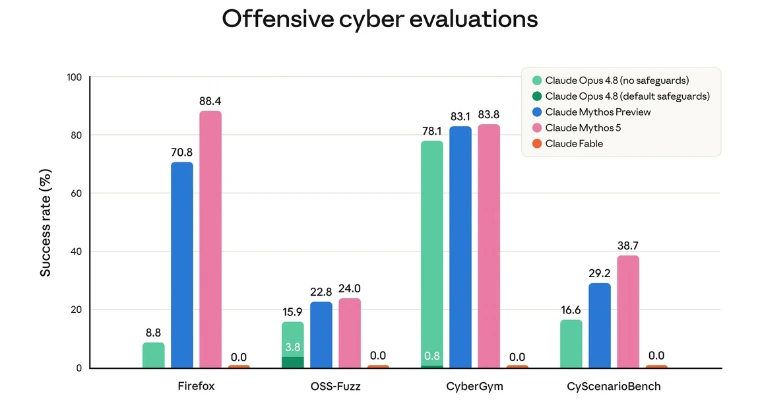
However, analysts contemplate whether the difference in Opus 4.8 answers queries that are harmful for humans. In this perspective, users are not devoid of this information, but a different model serves it. It questions the reliability and transparency of the models.
If unwanted information stems after the prompt callbacks to Opus 4.8, the responsibility still lies with Anthropic. Critics say that non-technical users will struggle to differentiate between Fable 5 and Opus 4.8; to them, the response is generated by Anthropic.
This disadvantage reflects a comprehensive challenge in the AI sphere. Security features that depend on switching models may reduce the intensity, but do not eliminate it. The issue will persist till usable responses are generated.
A Challenge for Frontier AI Regulation
The altercation poses a bigger shift: how should frontier AI models respond without compromising their quality? Organizations such as Anthropic, OpenAI, and Google DeepMind accelerate the adoption of a safety approach that includes policy constraints, evaluation, and monitoring systems. The aim is to ensure that frontier AI tools benefit users while decreasing the risk.
Anthropic Fable 5 reflects the philosophy that, instead of denying the request, the company routes it through a graduated access system, where processing the request may be constrained. Whether the approach becomes a norm remains under scrutiny. The effectiveness of the safety features will depend on how secure the fallback model proves to be and whether the redirected responses reduce consequences.
For now, the questions surrounding Claude Fable 5 pose a dilemma for frontier AI models. As models become autonomous, companies must facilitate the outputs within limited surroundings. Redirecting unauthorized queries to a weaker model may compromise the company’s integrity and also raise questions about transparency and accountability.