Meta’s new launch, Brain2Qwerty v2, depicts a historic change in how brain-computer interfaces are being created and assessed. Rather than declaring non-invasive brain decoding as a sole medical invention, Meta is creating it as a research platform built in the open. By releasing full training code for Brain2-40V1 and V2, alongside an open dataset from an academic alliance, the company invites the neuroscience and artificial intelligence communities to compete on efficiency, transparency, accuracy, and scale. The outcome is an ecosystem that uses surgical-grade performance without implants while redeveloping brain decoding as an iterative engineering issue.
What Brain2Qwerty v2 Actually Does
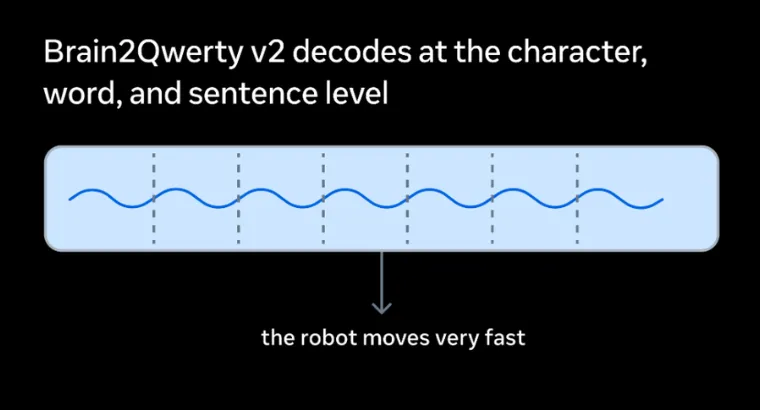
Brain2Qwerty v2 is an end-to-end artificial intelligence mechanism that decodes brain activity directly into the writing in real time, without any surgical implants. It depends on non-invasive magnetoencephalography recordings acquired while participants actively type. Instead of embedding handcrafted signal processing steps to recognize neural events, the mechanism applies deep learning models that decode directly from raw brain signals.
A key development is the fine-tuning of large language models on brain data. By embedding semantic information, the system can solve the gap between noisy brain recordings and lengthy, complex, coherent sentences. This allows Brain2Qwerty v2 to gather full sentences rather than single words or characters, making it distinct from earlier non-invasive approaches that could not achieve precision and fluency.
The long-standing benefit will be for millions of people with neurological issues or conditions that annihilate them from participating in conversations. Invasive techniques such as stereotactic, electroencephalography, and electrocorticography have depicted that artificial intelligence-driven neuroprostheses can regain communication, but these methods require brain surgery and are difficult to acquire. Meta’s non-invasive approach aims to heal that gap.
By avoiding implants at once, Brain2Qwerty v2 places itself as a joining mechanism between clinical success and real-time viability. Similarly, the direct audience for this work is the research community as well. By releasing the code and the context, Meta pushes other labs to generate, expand, and question its results rather than treating it as the final demonstration.
Also Read: OpenAI Is Testing Improved Excel and PowerPoint Controls for Codex
How Meta Trained It, and How Accurate It Is
The model was trained on approximately 22,000 sentences collected from nine volunteer participants. Each participant wore an MEG device for around 10 hours while typing, creating paired neural and text data. Meta also adopted artificial agents to explore different tactics across the decoding pipeline, with final configurations chosen manually by the engineers. The outcome represents a crucial jump over previous non-invasive methods. Brain2Qwerty v2 achieves a word accuracy rate of 61%, compared with about 8% reported for other non-invasive approaches. For the best-performing participants, word accuracy reached 78%, with more than half the sentences decoded with one word error or less. These outcomes show accuracy levels never previously seen, only in neurological, invasive methods.
Meta does not only show outcomes, it also releases the full training code for both Brain2Qwerty v1 and v2, while its alliance, the Basque Center on Cognition, Brain, and Language, is accommodating the V1 dataset. This shifts brain decoding into an open scaling issue rather than an organizational achievement. The company’s research shows that decoding precision improves log-linearly with extra data, suggesting that development gaps with surgical approaches could be reduced simply by scaling datasets. By making this tool available to the public, Meta is inviting others to test the mechanism. This ecosystem makes Brain2Qwerty less about proprietary success and more about how the ecosystem can push a non-invasive brain decoder forward.
Brain2Qwerty v2 fits into a larger effort to build base models of the brain. Meta is doing different related work such as TriBert for perception encoding, neural sets for processing brain data at a higher range, and Neural Bench for strategic assessment. These introductions are supported by a $5 million fund under the Digital Brain Project to push these datasets. Altogether, this places Meta as treating neuroscience more like an artificial infrastructure issue rather than a medical specialty. Brain decoding is something that improves with new benchmarks, open models, and community intervention, not just clinical development.
With Brain2Qwerty v2, Meta creates non-invasive brain decoding through one medical demo into an open-source resource platform that facilitates data collaboration in context. By joining surgical accuracy with open-coded datasets, the organization takes a step further in brain-computer interfaces, not from sole contributions but from competition and shared progress across the community.