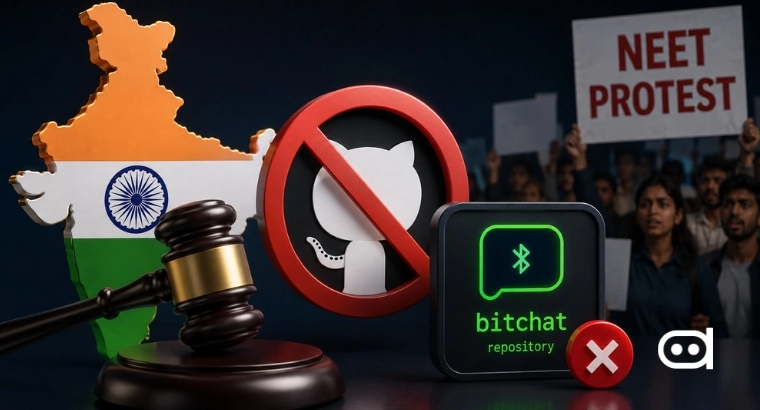
India’s Cyber Crime Coordination Centre has directed GitHub to remove three code repositories for Bitchat, the offline messaging app built by Block chief executive Jack Dorsey. The notice, dated July 23 and issued by I4C under the Ministry of Home Affairs, gave the Microsoft-owned platform three hours to comply.
The order became public when Dorsey posted screenshots of the notice on X on July 24, writing that the government of India does not like technologies like Bitchat and wants it taken down. ThePrint reported that it could not independently verify the notice and had contacted I4C for comment. I4C has not publicly confirmed the order.
What the I4C Notice Says About Bitchat
The three repositories named sit under the permissionlesstech account and cover the main project, its Android build, and the Android releases page. The notice invokes Section 79(3)(b) of the Information Technology Act, 2000 and Rule 3(1)(d) of the 2021 IT Rules, and references provisions of the Bharatiya Nyaya Sanhita. It instructs GitHub to remove and disable access while preserving evidence.
I4C describes Bitchat as a platform capable of decentralised peer-to-peer messaging over Bluetooth mesh networks without relying on mobile networks, internet connectivity, or centralised servers. The agency’s stated concern is that this architecture significantly impedes lawful interception, attribution, and investigation. The notice argues such platforms can be exploited for coordinating unlawful assemblies, violent protests, misinformation, radicalisation, and criminal conspiracies, and specifically cites use during riots, terrorism, organised crime, or internet shutdowns.
the government of india does not like technologies like bitchat and wants it taken down pic.twitter.com/gjzMg1NGCi
— jack (@jack) July 24, 2026
Bitchat requires no account, phone number, or internet connection. Messages route directly between nearby devices over Bluetooth, are end-to-end encrypted per the project’s white paper, and are stored in device memory by default.
Why the Timing Points to the Delhi Protests
The order lands during the Cockroach Janta Party protests at Jantar Mantar in New Delhi, where demonstrators have gathered over exam paper leaks and have demanded the education minister’s resignation. Authorities suspended mobile internet in parts of central Delhi around the protest site, and reports describe protesters turning to Bluetooth mesh apps to keep coordinating once connectivity dropped. Authorities have not confirmed that Bitchat specifically was used.
STORY 3: India blocks the app protesters just started using.
— Clear Signal News (@CSN24X7) July 24, 2026
📡 CSN24X7
#India #Bitchat #Censorship pic.twitter.com/tDwVJmhgd6
The Internet Freedom Foundation called the order unconstitutional and authoritarian. The digital rights group argued that Section 79 is not a general blocking power, that the notice identifies no specific unlawful content within the repositories, and that removing source code would not disable apps already installed on phones.
That legal mechanism is already contested. The Karnataka High Court is hearing a challenge from X to the constitutionality of both Section 79(3)(b) and Rule 3(1)(d), alongside I4C’s Sahyog portal. The government has defended the provisions, arguing the Section 79 process carries adequate procedural safeguards and is distinct from the Section 69A blocking regime.
What Happened After the Three-Hour Deadline
Whether GitHub complied within the window was unclear at the time of reporting, and Microsoft has not commented publicly. Bitchat remained downloadable from both Google and Apple stores on Friday. Copies of the repositories appeared on alternative code-hosting platforms within hours of the notice, which is the practical limit of a takedown aimed at open-source code that can be mirrored freely.
India is the second major market to move against the app this year. China required Apple to pull Bitchat from its China App Store in April, citing rules covering services with public opinion or social mobilisation capabilities. The app has previously seen download surges during protests in Nepal, Indonesia, Iran, Madagascar, and Uganda.
You can also read – Telegram Gets 15 Days to Act on Pirated Films in India