As the global AI hardware competition accelerates, the demand changes from training models to running them. To tackle this, NVIDIA has introduced its new Verasentric processors to the Chinese audience. These CPUs are available for data centers and will be available as early as August, sources say. The outreach comes as NVIDIA’s hold in China decreased due to delayed GPU shipments, U.S. export policies, and China’s push for domestic alternatives. Vera, NVIDIA’s sole standalone CPU designed for agentic AI, could potentially reshape how organizations compete in the restricted AI market.
Why is NVIDIA Introducing Vera in China Now?
Vera is NVIDIA’s standalone central processing unit built for agentic AI. These systems perform soaring tasks without human interference. Unlike NVIDIA’s other units that dominate acceleration, Vera is for behind-the-scenes computing, depending on inference and operation.
Vera relies on ARM technology and places NVIDIA against CPU players that depend on x86 structures. Vera can scale up to 1.8 times faster than other processors, spotlighting performance gain in critical workflows for AI data centers. The company launched Vera in March, with CEO Jensen Huang claiming it to be a highly unprecedented monetary business.
Similarly, NVIDIA also said that cloud companies, including Alibaba and ByteDance, were using it to deploy their AI chips, though it did not mention the exact time.
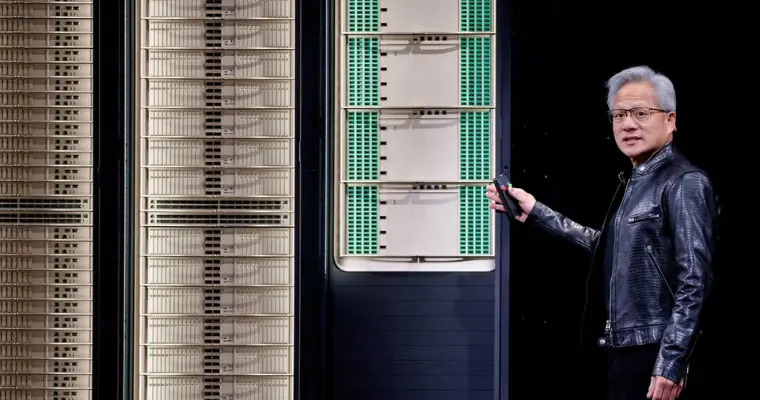
Nvidia’s outreach emphasizes its slipping hold in the country. The second most powerful chip, H200 GPU, has been stuck for months. NVIDIA’s market hold in China is falling to zero. The reason is the exercise of U.S. export controls and China’s focus on self-reliance.
Selling GPUs to China has proved fraught. While Washington has advised around 10 Chinese firms to buy the H200, not a single delivery was possible because of Chinese officials holding the approval. These restrictions affect the GPU sales, reinforcing its clout around NVIDIA’s core AI products in the nation.
Against this issue, central processing units deliver a less complicated path. Export duties on graphic processors are stern than those on central processors, making there a medium to re-enter the Chinese market without the friction.
Also Read: What To Expect From OpenAI’s Next GPT 5.6 Model, & How it Scales Against Claude Fable 5
Response From the Chinese Clients
According to sources, some Chinese companies have responded optimistically in Vera. One crucial Chinese company plans to invest in 300 servers, each equipped with two Vera CPUs. The systems will undergo testing with further adoption based on performance.
However, deployment is uncertain. Sources issue an advisory that software architectures, migration, and compatibility around domestic AI chips could slow the process. Price is another aspect. A single Vera processor is priced around $20,000 before discount, and a fully configured rack of 256 chips would cost around $10 million, depending on the memory storage.
Early shipments, which will go into huge ready-to-install racks, supplemented by hyperscalers with simpler two-processor servers, ramping up later. NVIDIA hopes the Vera chip sales will generate $20 billion in revenue by the end of the year in January.
As Vera steps into the market, the competition with major CPU firms such as Intel and AMD increases. As the competitiveness increases for inference computing, CPU and custom AI chips accelerate with GPUs. The shift induces a global CPU shortage. Intel informs Chinese customers of CPU delivery up to 6 months, while AMD warns that the condition of the global CPU market is tight. The demand outpaces the supply and the CPU continues to finish. Vera allows NVIDIA to enter this market full of restraints at a time when consumers seek replacements.
NVIDIA’s Vera CPU constitutes a strategic response to geopolitical barriers and changing AI workloads. By focusing on CPU for agentic AI, Nvidia aims to fill the gap for the GPUs created by export controls and the rise of x86 in China. Interest from Chinese companies suggests positivity, though high costs and regulatory challenges make the deal uncertain. Whether Vera becomes Nvidia’s mechanism to step back into China, or a stopgap in the hardware market, will depend on the adoption and how customers invest.