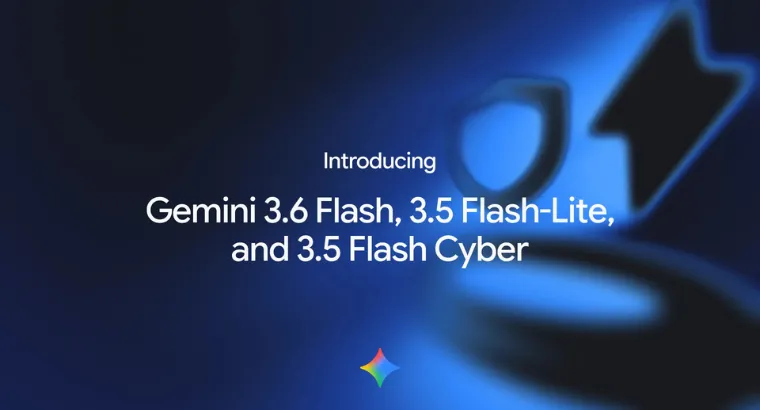
Google has rolled out Gemini 3.6 Flash with Gemini 3.5 Flash-Lite, extending its frontier AI family. While the declaration emphasizes coding capabilities, multimodal reasoning and fewer token consumption. There is a simultaneous representation of a huge shift previously visible in OpenAI’s GPT 5.6 lineup. Rather than competing through one model, both of them are bifurcating AI for distinct workloads. OpenAI unveiled GPT 5.6 Sol, Terra and Luna separating frontier reasoning from efficiency and inference. However Google is highlighting its models around effectiveness, latency and productivity. The comparisons facilitated depicts how economically models can execute substantial workflows.
Why is Google Releasing Gemini 3.6 Flash Now?
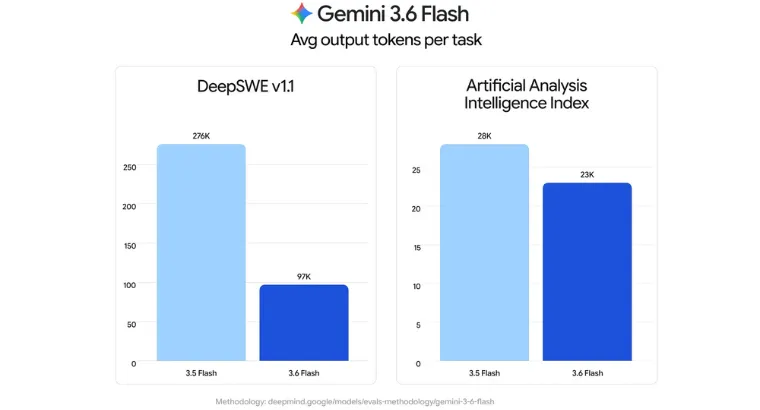
The timing shows a surging demand from organizations around sovereign AI systems as AI agents execute multimodal workflows involving coding, content, financial research, customer support, and software operations, inference costs become constraints. Large language models are efficient, but monotonous reasoning steps, multiple tool calls, and verbose responses affect the cost. Google says Gemini 3.6 Flash deals with reducing output token usage by 17% compared to Gemini 3.5 Flash on the Artificial Analysis Index, while also needing fewer reasoning steps and tool calls for workflows.
On deep SWE benchmarks, Google says reductions can be 65%, although those numbers depend on the input and workloads. Pricing depicts this strategy. Gemini 3.6 Flash costs $1.50 per million input tokens and $7.50 per million output tokens, making it less costlier than its previous model while improving coding capabilities, understanding, analysis, financial reasoning, and computer use capabilities.
Google also unveiled Gemini 3.5 Flash Lite, its quick production model capable of generating around 350 output tokens per second, according to artificial analysis. The model is created for high-end workflows such as source research analysis, translation, and lightweight agent orchestration at fewer costs. Unlike OpenAI’s ability first positioning with Sol, Terra, and Luna, Google’s Flash family focuses on optimizing costs at a magnitude.
How Is Gemini 3.6 Flash Distinct From GPT 5.6 Sol, Terra and Luna?
The two rollouts present similar product strategies. OpenAI bifurcated GPT into three productsGemini 3.6 Flash, Sol as the core reasoning model for coding, biology, cybersecurity, and long-standing tasks. Terra balances performance with fewer costs for proprietary adoption, while Luna targets latency-centric workloads when affordability and pace outweigh frontier reasoning. Google built its own ecosystem but with different mechanisms.
Gemini 3.6 Flash occupies the middle ground between performance and efficiency. It improves reasoning while reducing token generation, allowing developers to lower inference costs without sacrificing the ability. Gemini 3.5 Flash Lite facilitates optimization even further by focusing throughput and response speed for environments handling multiple requests. Instead of asking consumers to choose between smart and cheap, both companies are letting developers to balance specific AI models to the workloads.
This shows a crucial shift in proprietary AI adoption. Organizations do not need an expensive reasoning model for every task. Many production pipelines require simple operations like retrieval, summarization, organization, or routing, making lower-cost models a definite choice. The result is that frontier AI is moving from one model to different models within larger agentic systems.
Google’s declaration also includes Gemini 3.5 Flash Cyber, a new cybersecurity model embedded into CodeMender, where multiple AI agents participate to recognize and nitpick software vulnerabilities. Unlike the public Flash model, Flash Cyber will only be available through a restricted access pilot for federal authority and trusted partners, reflecting the sensitivity around cyber capabilities.
What Gemini 3.6 Flash Means for AI Costs
The distinction between Google’s flash models and OpenAI’s GPT-5.6 suggests that efficiency is a core aspect. Previously, AI companies competed to build large models. Today, organizations value inference cost, latency, token efficiency, and operational scalability as well. Google’s focus on reducing reasoning steps, minimizing unnecessary output, and reducing per-task cost addresses these issues. OpenAI has structured GPT-5.6 around differentiated capability levels, so organizations can choose between maximum reasoning, balanced performance, or quick low-cost inference.
Both approaches aim towards the same thing, where future AI systems will consist of multiple specialized models rather than one sole model. However, safety is a distant feature. Gemini 3.6 Flash introduces strong protections against cyber and CBRN misuse while aiming to reduce unnecessary refusals for legitimate users. OpenAI similarly paired GPT-5.6 rollout with extensive government-certified safety testing, restricted reviews, automated red teaming, and layered security safeguards before adoption.
As AI models become sovereign, organizations begin to compete on a balance of effectiveness, cost, safety for real-time agentic applications. Gemini 3.6 Flash represents more than another model release. Together with GPT-5.6, Sol, Terra, and Luna, it demonstrates that frontier AI is stepping into a new realm of efficiency.