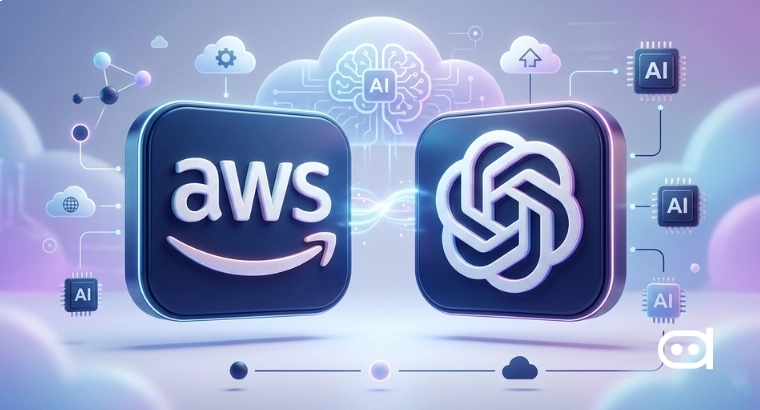
- AWS (Amazon Web Services) just announced that OpenAI’s latest AI models are coming to Amazon Bedrock, which means more businesses can get access to advanced AI tools.
- This update, released in April 2026, shows how OpenAI is moving away from its close Microsoft Azure partnership and opening up to other cloud providers.
- Companies can now run OpenAI models directly from AWS, combining AI capabilities with already existing security, compliance, and scalability systems.
OpenAI isn’t sticking to just one cloud provider anymore. By moving its models to Amazon Bedrock, OpenAI is turning into a more neutral, platform-focused player. Meanwhile, AWS strengthens its appeal as the go-to spot for enterprise AI.
Businesses demand flexibility in how and where they deploy AI. They don’t want to be restricted to a single vendor; they prefer flexibility and are increasingly opting for multi-model, multi-cloud setups which are the new standard. Introducing OpenAI’s models to Bedrock along with other providers, shows how cloud giants are battling to host the best AI systems in the market.
OpenAI Models are Now Available on Amazon Bedrock
Bringing OpenAI’s models into Amazon Bedrock adds a new dimension to AWS’s managed AI service. Bedrock connects companies to several foundation models through one API, making it easier to build, test, and scale applications without worrying about infrastructure. With OpenAI’s arrival, AWS customers gain direct access some of the most advanced generative AI capabilities available.
For organizations already operating within AWS, this means less hassle. They can use OpenAI-powered apps without moving data or shifting workflows elsewhere. That’s a real win for compliance, data governance, and latency which are key issues in finance, healthcare, and government.
This move also signals the push toward interchangeability. Instead of trapping users with one AI provider, Bedrock gives people choices. Developers can pick different models based on price, performance, or their exact personal needs. Adding OpenAI strengthens this promise, especially for anyone wanting top-level language or reasoning tools on familiar cloud ground.
Also read: OpenAI Closes Historic $110 Billion Funding Round Backed by Amazon, NVIDIA, and SoftBank
Introduction of Codex and Developer Tools
In addition to its main models, OpenAI is bringing developer tools like Codex into AWS. Codex helps with code generation, software development, and automating tasks, making it easier to weave AI into daily engineering.
Developers can use these tools across command-line interfaces, desktops, and popular editors, so they don’t have to constantly switch between different environments. Coding agents handle the repetitive tasks which lets engineers focus on bigger design and problem solving.
Another big change here is the rollout of managed AI agents within Bedrock. These agents handle multi-step workflows, keep context, and execute tasks on their own. For businesses, this means expanding automation. For example; customer support that resolves all your queries end-to-end, or internal tools managing data pipelines without manual labour.
Focusing on agents highlights how enterprise AI is moving beyond just simple chatbots. Companies will start using systems that think for themselves within clear guidelines, combining reasoning with access to enterprise data and services. AWS’s infrastructure gives them scale and reliability, and OpenAI’s intelligence makes these systems smarter.
Conclusion
The AWS and OpenAI partnership is a big moment for enterprise AI. By adding OpenAI models to Bedrock, both companies meet the growing demand for flexibility, compatibility, and integration. AWS becomes more competitive in the cloud market and OpenAI gets wider distribution and less dependence on a single platform.
As firms dig deeper into generative AI, combining strong models with trusted cloud infrastructure will drive adoption. This deal accelerates the competition between cloud providers and initiates a future where AI is incorporated deeper into business systems, workflows, and decisions.