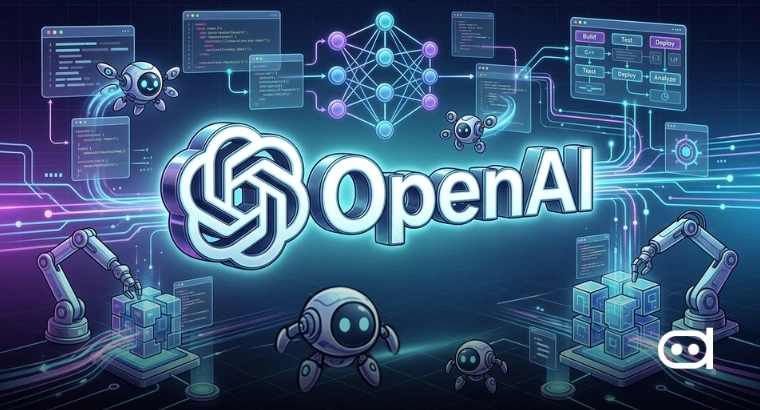
- OpenAI has launched the OpenAI Symphony orchestration system which is an open-source framework built to automate software development workflows with AI agents.
- Symphony was announced as a part of OpenAI’s broader attempt at making autonomous coding agents.
- It connects task management tools to AI systems like OpenAI Codex and lets them handle development work from start to finish.
Symphony isn’t just helping developers by responding to prompts, it actually converts project boards into engines that get tasks automatically picked up, implemented, and submitted for review by AI. This marks a real shift in how software might be built soon. Tasks like interpreting requirements, coding, testing, and submitting aren’t the developer’s job anymore, the AI agents take care of all that inside orchestrated workflows.
At the core of Symphony, it brings together familiar tools like issue trackers, repositories, and testing systems, then layers on orchestration logic. Teams get to set high-level goals, and the AI handles the execution. The idea is to change how they work and not to push developers out entirely.
How Does Symphony Actually Work
Symphony’s biggest move is far away from prompt-driven interactions. Tools using OpenAI Codex used to need users prompting them step by step. With Symphony, the need for that kind of extra work is not there anymore, AI is now embedded straight into your workflow.
Instead of asking the AI to “write a code”, developers can just add tasks like “build a login system” to the board. Symphony reads the task, starts off with an implementation run, and tries to complete everything on its own. By assigning just one task, you get the whole package, that is, reading the codebase, writing new code, running tests, and generating requests. It’s not about being perfect at prompting anymore but about spelling out clean and structured tasks. Your task board basically becomes the new platform for collaborating with AI.
Also read: OpenAI’s New GPT-5.5 Model Beats Claude Opus 4.7 in Major Benchmarks
What Happens Inside an Implementation Run
Every implementation run acts as its own small workspace. When Symphony sees a task, it gives it to an agent that operates in isolation. That way, experiments and errors won’t mess up the rest of the code. The agent tackles the task like a human would; it starts by understanding what needs to be done, checks relevant files, writes or adjusts code, runs tests, and loops if problems come up. Once it’s satisfied with the result, it creates a pull request for the humans to review.
This setup lets teams run a couple of tasks at once as dozens of implementation runs can work along in parallel, with their respective tasks. That parallel processing is a big reason behind reports of increased productivity. And these runs are repeatable as well. If something goes wrong, the system makes another attempt with changes. It adds resilience and lets teams experiment in ways you just can’t with classic workflows.
What Impact does Symphony have on Developers and Development Workflow
As Symphony and similar systems develop, they’re changing the whole idea of what software development actually means. The emphasis moves from writing code line by line to managing processes, designing requirements, and checking results. Developers are still necessary, majorly for setting up workflows, maintaining quality, and making important decisions, but for daily coding they’re becoming less central. Developers will start acting more like operators who monitor and guide the AI agents working together.
This change also raises some questions about teamwork and accountability. Even though AI writes the code, the humans managing the systems would still be held responsible. Repetitive work means developers can focus on bigger problem solving and design. For companies, it means faster updates and more output without needing bigger teams.
Wrapping Up
Symphony is a real step towards autonomous software engineering. By turning task boards into execution engines and letting AI agents handle everything from start to finish, it changes old assumptions about how software gets built. The technology’s still new, but you can see where things are headed in the future. Development is moving away from manual, prompt-driven work and towards structured, automated workflows. The role of the developers change, but it’s not completely going away, developers will monitor and shape the systems that do the actual coding.