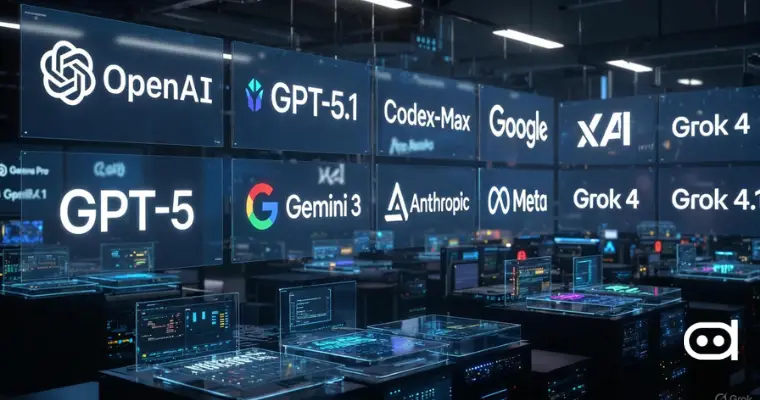
2025 was a major turning point for artificial intelligence, wherein the development of models sped up the areas of multimodal reasoning, advanced coding, autonomous agents, and real-time deployment. The big AI laboratories went far beyond just making small improvements to their systems and presented consumers with models that had an enormous increase in their context length, reasoning depth, visual understanding, and developer control. The fast pace at which innovation was taking place, had an impact on the expectations from AI in enterprises, consumer applications, and research workflows. This article emphasizes the most significant AI Model Releases in 2025 and offers a clear AI model comparison 2025.
Key Takeaways
- AI innovation roundup 2025 was a clear indicator that the progress made was not only on a linear path but also that it had a compounding effect across various modalities and capabilities.
- The multimodal models became the norm rather than the exception.
- Reasoning, coding, and agentic workflows experienced a drastic increase in dependability and scalability.
- The open and closed models advanced very quickly, providing developers with a larger range of choices than ever before.
- Image and 3D understanding have been acknowledged as major frontiers and not as mere side features.
- In the latest AI models 2025, the focus has been on real-world deployment issues, like performance, safety, and integration, rather than academic benchmarks alone.
List of Major AI Models Released in 2025
- OpenAI GPT-5 / GPT-5.1
- Google Gemini 3
- Anthropic Claude 4 (Opus & Sonnet)
- Meta Llama 4 (Scout, Maverick)
- xAI Grok 4 / 4.1
- Google Nano Banana Pro (image model)
- Meta SAM 3D
- OpenAI Codex-Max
Key AI Model Releases of 2025
OpenAI GPT-5 & GPT-5.1
OpenAI rolled out its finest general-purpose model so far, termed GPT-5, in August 2025, and shortly thereafter, GPT-5.1 launched in November, focusing on stability, efficiency, and developer feedback. As for new features, GPT-5 was able to do more than ever before with logic and reasoning via its handling of multimodal inputs consisting of text, images, and structured data. The introduction of version 5.1 paved the way for improvements in latency, tool use, and instruction following, making it the most production-ready version yet. Altogether, the GPT version timeline not only secured OpenAI’s position in the AI enterprise but also in the area of advanced assistants and research tools. The developers particularly benefited from GPT-5’s better planning and GPT-5.1’s reliability for long tasks.
Google Gemini 3
Google’s Gemini 3 signified an extensive advancement in multimodal AI systems. The Gemini 3 launch in November 2025 primarily focused on reasoning not only over text but also over code, images, and video, while being deeply integrated with Google’s developer ecosystem. The model is very impressive when it comes to assisting in coding, data analysis, as well as in agent-based workflows through Google AI Studio and Vertex AI. Gemini 3 also enhanced its controllability and safety, which were in line with Google’s enterprise-first strategy. For developers, a unique feature was the problem-free deployment across different cloud services and productivity tools, which made Gemini 3 a feasible option for creating scalable AI-powered applications.
Anthropic Claude 4 (Opus 4.5 & Sonnet 4.5)
In May 2025, Anthropic launched Claude 4, which provided two major variants: Opus 4.5 and Sonnet 4.5, which were the primary models trained on reasoning transparency, long-context understanding, and safety-aligned behavior. Claude 4 performed exceptionally well in three areas: document analysis, research workflows, and enterprise knowledge tasks, where particular accuracy and explainability were required. While Opus aims for maximum capability, Sonnet aims for a balance between performance and efficiency. The launch solidified Anthropic’s distinction around trustworthy AI, making Claude 4 exceptionally attractive for regulated industries and organizations focusing on engagement and interpretation.
Meta’s Llama 4 (Scout & Maverick)
Meta’s Llama 4 launched in April 2025 with the Scout and Maverick models that are suitable for different deployment conditions. Scout concentrates on efficiency and performance compatibility, while Maverick offers advanced reasoning and multimodal capabilities. Llama 4 offers access to the ability to process text and images and create and run agent-like workflows, which gives the developer the chance to be more creative in model customizing and deploying. This launch marked a notable increase in Meta’s presence in the open-source AI arena, unlocking new avenues for innovation and custom solutions from startups and researchers who were no longer strictly dependent on proprietary platforms.
xAI Grok 4 / 4.1
In July 2025, xAI launched Grok 4 and the upgraded Grok 4.1 in November, which emphasized real-time reasoning and live data integration. Grok 4 mainly targeted conversational intelligence and contextual awareness, while Grok 4.1 improved accuracy, latency, and instruction adherence. The two models are notable for their close connection to real-time information flows and social context, which is in line with xAI’s vision of developing more grounded and reality-aware AI systems. A Grok 4 review and the comparison of Grok 1.0 to 4.0 are helpful for those who are interested in a deeper evaluation of how quick the evolution of the model has been.
OpenAI Codex-Max
The Codex-Max launch in November 2025, which was introduced together with GPT-5.1, signified OpenAI’s renewed dedication to AI-assisted software development. Codex-Max, which was built with coding tasks specifically in mind, is a large codebase understanding, refactoring, test generation, and multi-file reasoning expert. Contrary to generic models, Codex-Max keeps deterministic outputs and developer control as its top priority. As a result, it is particularly useful for enterprise software engineering teams, CI/CD automation, and long-term code maintenance. Codex-Max also illustrates that the specialized models are becoming more necessary as supplements to the general AI systems.
Google Nano Banana Pro
The Google Nano Banana Pro launch in November 2025 was a next-generation high-performance image generation and manipulation model. It captured the market with its super-detailed visuals, art style control, and speedy inference. The model has proved its place in product design, marketing, and its release highlighted that the image models were going in the direction of professional-quality images and no longer experimental art tools. Nano Banana’s 3D figurines trend has also gained traction with small statues and art pieces that work like keepsakes.
Meta SAM 3D
Meta’s SAM 3D launched in November 2025 and took the Segment Anything Model into full 3D comprehension, launching a foundational tool for spatial AI. Every 3D scene could be cut into segments, thus a wide range of applications like robotics and AR/VR, gaming, and digital twins got the advantage. The model proved that computer vision is no longer restricted to flat images, but it is now gradually moving towards spatial intelligence. For the developers who are making immersive or physical-world applications, SAM 3D is nothing less than a vital infrastructure layer for the AI systems of the future.
Conclusion: AI technology roundup 2025
The AI model roundup of 2025 clearly indicates the transition from singular breakthroughs to an intelligent, integrated, and ready-for-production era. The multimodal reasoning, specialized coding models, open ecosystems, and 3D understanding are all advancing together. For developers, product managers, and AI enthusiasts, 2025 offered not just more powerful models but clearer pathways to real-world impact. As the industry moves forward, these releases will likely serve as the cornerstone for the next generation of AI-driven products and platforms.