Technology has always changed how wars are fought. From swords and gunpowder to nuclear and cyber warfare, past periods have all created new ways to win and lose battles. In today’s world, digital warfare is about dominating people, controlling their data, communication, and infrastructure. However, we are now transitioning to the next level of warfare, called the Intelligence Age.
AI in future wars will redefine military strategy and how militaries operate their forces more than any other concept. Unlike any other technology, AI is not just an enhancement of existing systems but also a means of enabling machines to consider, evaluate, and implement decisions with little to no human involvement. Consequently, all defense agencies around the globe are investing enormous sums in AI military systems to gain strategic advantages, improve operational efficiency, and respond quickly to new threats. The use of AI as a war-fighting tool signifies a monumental change in the future of war.
The Growing Role of Artificial Intelligence in Modern Warfare
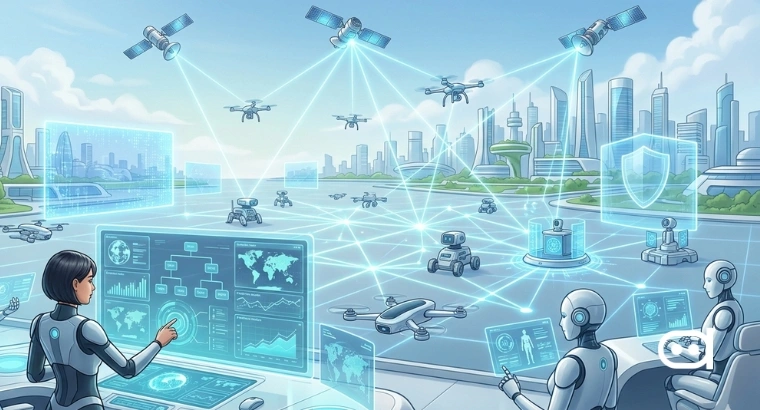
The use of artificial intelligence in warfare has become practical and is impacting how militaries employ themselves. Countries are adding artificial intelligence capabilities to AI defense systems in intelligence, surveillance, and reconnaissance (ISR) activities. Such systems collect and analyze data from satellites, drones, and other sensors in real-time, providing faster and more accurate information to decision-makers.
As a result, militaries can utilize AI-based analytics to identify patterns, anticipate the movement of hostile forces, and make better decisions regarding battlefield plans. As an example, AI-powered ISR systems can detect troop movement patterns, track border activity, and analyze communication signals with unprecedented accuracy.
Using AI in military strategy can provide command and control systems with real-time recommendations to help with rapid decision-making. In modern warfare, this is extremely important because the success or failure of a military operation is often determined by how fast a decision is made. As the use of AI-based defense systems continues to advance, they will play an increasingly important role in ensuring that situational awareness and operational superiority are achieved.
Autonomous Weapons Systems in AI-Powered Warfare
The introduction of autonomous weapons systems is an evolving AI military technology that can significantly impact AI in modern warfare. These platforms have different levels of autonomy, from merely assisting human operators through to completely autonomous decision-making related to target selection.
Autonomous weapons rely on AI technologies such as computer vision, sensor fusion, and deep learning to locate, track, and engage targets. Autonomous weapon systems are effective in combat due to their ability to utilize real-time information for faster decision-making when targeting.
Some examples of autonomous weaponized systems are the following:
- US Air Force RQ-4 Global Hawk unmanned aerial vehicle (surveillance) – Uses multiple sensors to conduct 24/7 aerial reconnaissance.
- US Navy’s Unmanned Carrier-Launched Airborne Surveillance and Strike (UCLASS) Program – In development, this program will provide surveillance and strike capability to carrier group commanders, but the specific types have yet to be decided.
- US Army’s Robotic Systems Joint Program OUVS—an unmanned combat vehicle currently in the testing phase.
- US-Australian Joint Amphibious Robotic Combat Vehicle – An emerging capability for both forces in the testing phase.
These technologies facilitate operational efficiency while reducing the potential for loss and injury to human life. However, the increasing reliance on completely autonomous weapon systems raises concerns about how such systems will be controlled and accountable to local and international laws.
AI-Driven Cyber Warfare and Intelligence Gathering
AI is becoming an integral component of all aspects of warfare due to the increasing digitization of global conflicts. There are now AI-based tools that can be utilized to identify, prevent, and respond to cyberattack attempts in real-time. Some examples of how AI is being utilized in cyber operations include using advanced algorithms to detect aberrant network activity, predict possible exploitable vulnerabilities, and suppress threats before they can develop.
In terms of gathering intelligence, AI is used extensively to analyze large amounts of information from many sources, including communication, social media, and satellite imagery. This allows for more expedient and accurate assessments of potential threats.
Furthermore, in recent years, AI has enhanced the capabilities of electronic warfare (EW) by disrupting enemy communication systems and protecting critical infrastructure. Cyber threats are becoming increasingly sophisticated, and because of this, the use of AI-based defensive mechanisms is crucial to ensuring digital battlefield security and resilience.
Benefits of AI in Future Military Operations
There are several strategic benefits to utilizing AI within the military:
- AI allows real-time data analysis that enables quicker decisions
- It offers increased accuracy and precision in targeting
- There is reduced risk to human soldiers in high-risk areas
- AI in future wars operations provides improved surveillance and situational awareness
- It offers more efficient logistics and resource management
- AI can predict enemy actions and operate 24/7 without experiencing fatigue or limitations
Because these benefits enhance an organization’s military capability and operational preparedness, they make AI a force multiplier.
Ethical and Security Challenges of AI in Warfare
Although AI has various benefits in warfare, it raises serious ethical and security issues.
- Accountability gap, or how to decide who takes responsibility if an autonomous system causes unwarranted damage
- Absence of human oversight, or how to monitor the actions of fully autonomous systems that may not act reliably in highly complex environments
- Potential for accelerated decision-making that may lead to inadvertent conflict
- Issues of bias inherent in every AI algorithm, as they will likely reflect the biases found in the training data used to develop them
- Proliferation of advanced AI weapons to non-state actors
- Legal ambiguity of AI-driven warfare under current international law
Such issues point to a need for developing regulations and guidelines regarding ethical uses of AI in military situations.
Global AI Arms Race
Worldwide, the rapid development of military artificial intelligence has triggered a new arms race. Powerful nations invest enormous sums into developing their capabilities in this area to gain an edge over their adversaries. In fact, the competitive environment surrounding military AI investment involves not just developing weapon systems but building out data infrastructures, acquiring computing resources, and attracting top talent.
As the competitiveness between nations for strategic advantage continues to grow, we see that AI will be a determining factor in superior military capability going forward. Many countries are currently focused on developing the concept of “Sovereign AI”, AI technologies that do not rely on foreign technology but are built using sovereign capabilities either independently or through collaboration with other countries. Sovereign AI is important for establishing and maintaining a nation’s security and sovereignty over sensitive military systems.
Competition to achieve technological superiority in AI also involves establishing the future rules and patterns of the conduct of war. Countries leading efforts to develop AI capabilities on a national level are likely to determine or influence most of the current global standards and norms associated with the use of military force and how nations perceive and react to each other in an international context.
The Future Battlefield: Human-AI Collaboration
Though AI is changing how wars are fought, humans still play an important role in warfare going forward. The future of AI warfare will be a partnership between humans and intelligent machines instead of total automation.
The presence of a human voice provides ethical-based decision-making and contextual interpretation that an AI system does not provide. Soldiers using AI as tools will have a greater capacity to make timely and accurate decisions regarding threats and respond faster and better to threats, as well as coordinate more complex operations.
Future defense strategies will be based on human intelligence combined with AI, integrating the most efficient use of machines to enhance but not replace human judgment. This hybrid of man and machine will serve to maximize operational efficiency and uphold accountability and authority.
Conclusion
AI is expected to be an increasingly influential factor in future warfare, whether using autonomous weapon systems or cyber operations developed specifically using AI. Thus, it will impact military strategy and redefine global security as we know it.
AI’s advantages in speed, accuracy, and efficiency make it an integral component of modern defense systems. But the emergence of AI technology within warfare also creates considerable ethical and security-related challenges. Thus, addressing these issues will require cooperative international efforts, the implementation of proper regulations, and responsible innovation.
The current trend towards the development of AI technology for military use indicates a future of global conflict that will depend on the balance between technological development and ethical responsibility.