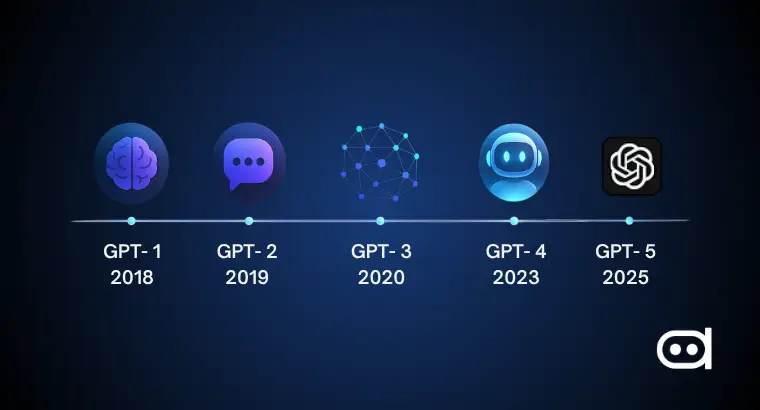
The evolution of generative AI models has produced successive model updates that enhance machine language processing, language generation, and reasoning abilities. OpenAI improved GPT-4 through its various updates, which solved problems related to coherence, reasoning, and scalability from earlier GPT models to the current version. The results of GPT-4 testing showed three main weaknesses, which included problems with handling extended text, maintaining operational effectiveness, and showing readiness for actual use, according to common GPT-4 limitations reviews.
The introduction of GPT-5.2 improves existing features through practical changes instead of introducing major new elements. The parties involved in developing businesses and content creation need to comprehend GPT-5.2 improvements because these determine their selection of particular model variants.
Inside GPT-5.2: Next-Level AI Innovation
GPT-5.2 represents a maturity upgrade that relates to the complete OpenAI model comparison system. GPT-5.2 features establish new functional elements on top of the existing GPT-5 architectural design by enabling enhanced logical reasoning abilities, extended contextual retention, and better overall performance in business-related tasks. GPT-5.2 aims to emulate the mental processes and professional work methods of expert workers through its design. The system approaches its goal through three core competencies, which include understanding intricate challenges, managing extensive data, and executing complex procedures while minimizing errors.
The testing results show that GPT-5.2 produces improved performance because it requires users to provide specific directions while generating less false output compared to previous systems. OpenAI uses the model to demonstrate its dedication towards developing AI systems that can operate efficiently in actual environments instead of concentrating on strictly research-related efficiency advancements.
GPT 5.2 users can select from three operational modes, which enable them to balance their work requirements between fast processing and comprehensive analysis.
- The Instant Mode functions at maximum speed for its users because it provides quick answers through its fast response system, supporting basic tasks, short chat sessions, and translation needs.
- The Thinking Mode provides a system that helps users develop structured thinking patterns for their professional work needs. The process requires additional time because it provides improved logical results, resulting in better outcomes for work that requires technical expertise or a complex understanding.
- The Pro Mode delivers maximum precision through its extensive content examination capabilities. The system supports high-quality work, which requires complex coding, specialized research, and comprehensive work assessment at enterprise standards.
Comparison Table: GPT-4 vs GPT-5.2
| Feature | GPT-4 | GPT-5.2 |
| Text Generation Quality | High creativity with occasional inconsistency | More structured and context-aware responses |
| Reasoning & Problem Solving | Strong but prone to logical drift | Improved multi-step reasoning accuracy |
| Context Handling | Limited long-context stability | Enhanced long-context retention |
| Multimodal Capabilities | Text and image processing | More stable multimodal reasoning |
| Coding & Technical Tasks | Effective but verbose | Cleaner, optimized code generation |
| Speed & Efficiency | Higher latency | Faster response times |
| Bias & Ethical Concerns | Ongoing mitigation | Improved alignment and filtering |
| Pricing | Input: $2.50 per million tokens Output: $10.00 per million tokens | Input: $1.75 per million tokens Output: $14.00 per million tokens |
New Features in GPT-5.2
This release contains several important GPT-5.2 improvements which include:
- Advanced Agentic Coding: The system provides efficient performance when handling extended periods of work that require multiple steps to execute across extensive code collections. It demonstrates high performance when handling intricate code changes and code transformation tasks, which involve turning user interface designs into operational prototypes.
- Deepened Reasoning and XHigh Setting: The system introduces a new reasoning effort level, which allows users to make decisions through a more deliberate process that requires multiple steps and produces better decision outcomes.
- Expanded Context: The context window has expanded to approximately 400,000 tokens, with great accuracy on multi-needle retrieval tests, allowing it to maintain, analyze, and recall information over very long conversations.
- Enhanced Vision Capabilities: GPT-5.2 Thinking reduces error rates on chart, graph, and technical diagram interpretation compared to previous versions.
- Improved Tool Efficiency: The system provides enhanced tool usage capabilities through custom tool creation and API connections while generating formatted output that uses less excessive language to deliver clearer information.
- Reduced Factual Errors: The model is approximately 30% more accurate than GPT-5.1, offering higher reliability for professional and analytical tasks.
Limitations of GPT-5.2
The system presents certain weaknesses. Evidence shows that human supervision, combined with subject matter knowledge continue to be a necessary element for GPT-5.2 improvements over GPT-4.
- The system works well in the Thinking mode, but users found that it cannot handle extended, intricate, multiple-step reasoning tasks, which result in contradictory results and failure to meet required constraints.
- GPT-5.2 exhibits a more mechanical and robotic behavior because of its advanced security measures and excessive training compared to earlier versions.
- The Thinking mode requires more processing power than earlier system versions because it operates at a speed that exceeds its previous performance by five to ten times.
- The model can be difficult to steer and may fall into loops, where it continuously repeats the same incorrect response even after being corrected.
Our Verdict: Which Is Best for You?
The decision between GPT-4 and GPT-5.2 requires assessment of two factors, which are your intended purpose and the size of your project. The development and operational teams can reap advantages from using GPT-5.2 because it improves their operational efficiency, output consistency, and ability to manage different situations. The enhanced ability to follow instructions that creators and analysts acquire enables them to achieve more consistent results. Users who conduct light testing or experimental work will find sufficient capabilities in GPT-4. The OpenAI model differences identify GPT-5.2 as a development-focused performance enhancement.
FAQ’s
Is GPT-5.2 better for coding and technical tasks?
Yes, the GPT-5.2 improvements result in better code generation and debugging capabilities, together with enhanced logical coherence.
Can GPT-5.2 replace GPT-4 entirely?
For most production environments, yes. However, GPT-4 may still be adequate for low-complexity use cases.
Are there new ethical or privacy considerations with GPT-5.2?
The GPT-5.2 features provide enhanced safety measures, but organizations need to establish control mechanisms, transparent practices, and conduct human evaluations to achieve ethical deployment.