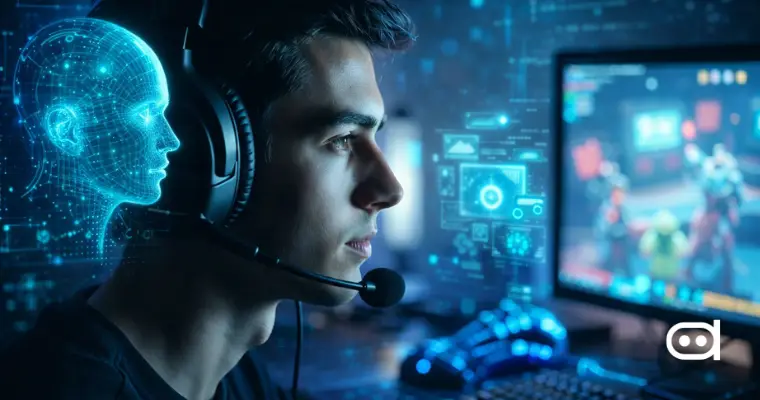
AI in gaming has come a long way in the last couple of decades. Initially, it was used just for creating some simple non-player characters (NPCs), but now it has given way to complex systems capable of creating dynamic experiences. Developers are already taking advantage of machine learning and generative technologies to create even smarter worlds. This phenomenal transformation indicates that AI is getting increasingly powerful and pervasive in gaming, where gamers will be more engrossed, have their game tailored to their liking, and the game will be more interactive than ever before.
Understanding AI in Gaming
The simplest way to understand AI in gaming is through NPCs. These systems give these characters the ability to fully interact with players and replicate how real characters would socialize with AI in the games market, these systems enable NPCs to react to player actions, adapt strategies, and create believable interactions. From enemy behavior to procedural world generation, artificial intelligence in games plays a central role in shaping player experience. Modern AI in games is no longer constrained by fixed scripts, and the game can now dynamically respond and create different outcomes for each play.
The Early Days — AI’s Role in Classic Video Games
The history of AI in video games can be traced back to simple logic-based arcade and console titles, where the behavior was controlled by very basic rules. The classic game of Pac-Man, for example, merely used a basic algorithm to imitate an intelligent pursuit, while the other genres relied on predefined decision trees. Although no learning capabilities were involved, these primitive systems nonetheless made it possible for the future to progress. Early-game AI did prove that artificial intelligence could create challenge and engagement, thereby opening up the path for more complex implementations.
Key Components of AI in Video Games
The core of AI in game development is path finding, decision-making, and behavior modeling. Finite state machines, behavior trees, and neural networks are some of the approaches that help non-player characters (NPCs) to move around the game world, respond to their environment, and even cooperate with other characters. The AI can interpret how the player plays and modify the level of difficulty thanks to the data-driven systems. All the mentioned components have come together to create the most basic part of AI in video games, which is that of the players experiencing games more naturally and realistically.
How AI Is Shaping Game Design and Development
AI has become essential to game development and design, simplifying the process and boosting overall creativity. Developers resort to AI in their effort to automate testing, create assets, and bring gameplay elements into balance. This cuts down on production time and gives rise to the creation of more intricate worlds. Consequently, AI has also empowered gaming studios to innovate faster, regardless of their size, providing a global audience with unbeatable and diverse experiences.
Machine Learning in Game Development — A New Era
Machine learning in game development is a big step forward from the use of static scripts to that of adaptive intelligence. In contrast to traditional AI, machine learning models depend on data and thus allow NPCs to change their tactics according to the player. Through reinforcement learning, characters can improve their choices gradually, producing unanticipated and exciting gameplay. Such techniques are leading to a new definition of AI in the gaming sector, making it even harder to distinguish between games and real-life intelligence.
Generative AI in Video Games — Creating Worlds Like Never Before
Generative AI in gaming is a great change in video games, and it is responsible for the revolution in content creation. By employing algorithms that are capable of producing assets, narratives, and environments, video game creators are enabled to efficiently construct vast worlds. The incorporation of generative AI in video games is not limited to procedural level design, dynamic storytelling, and even AI-created dialogues; it guarantees that each session is unique and that no two experiences are alike by making it all possible.
Key Applications of Generative AI
Among the major tasks for generative AI in gaming are creating terrains, character models, quests, and adaptive storylines. It also plays a key role in producing music and soundscapes that are in tune with the gameplay. By doing so, the quality of user experience is greatly enhanced, while being a major contributor to the entire process of scaling and creativity.
Challenges and Ethical Considerations in AI Game Development
There are certain disadvantages of AI in gaming:
Ethical and Creative Challenges
Over-reliance on AI can bring about a reduction in human creativity. That said, the quest to find the right balance between automation and artistic vision continues in the realm of artificial intelligence in video games.
Data Privacy and Fairness
AI systems are dependent on data from players for smooth functioning. So, the establishment of a trust relationship in the industry through privacy and fairness is going to be really important—especially when it comes to Online Gaming Safety for Kids, where data protection and ethical AI practices matter the most.
Technical Limitations
High computational requirements and intricate processes can make it hard to access, particularly for smaller studios.
Security Issues and AI Manipulation
With AI, online gaming players can cheat or gain unfair advantages, which makes the gaming world’s integrity and security issues more prominent.
The Future of AI in Gaming Industry
The gaming industry will rely on deep learning, reinforcement learning, and merging with VR and AR. The presence of AI-powered companions, adaptive storylines, and hyper-personalized experiences will be ubiquitous. The discussion of such developments at the Times of Games and Global Game Show events has already indicated that AI is going to change the course of interactive entertainment universally.
Also Read More About Top AI Video Generators that can transform your Creativity in 2026
Final Thoughts
AI in the gaming industry has ushered in various transformations from primitive logic-based NPCs to adaptive and learning-driven systems. With the growing potential of artificial intelligence, the entire process of video game creation and play is evolving significantly, encompassing aspects of creativity, efficiency, and immersion. The technology will give way to new advancements and will come with personalized and engaging gaming experiences, which will undeniably herald an exciting time for both players and developers.
FAQs
How can AI improve game resource management?
AI dynamically reallocates resources by optimizing enemy spawns and item distribution systems, among others.
In what ways does AI improve video game gameplay?
AI and game development have made the games more realistic, customized their difficulty, and made the environments responsive, among other things.
What is the role of AI in gaming industry?
AI is the source of innovative design, automation, and tailored player experiences.
How is AI used in video games today?
It is the key player in animating NPCs, creating content algorithmically, performing quality assurance testing, and analyzing player behavior.
What does the future of AI in gaming look like?
The future of AI in gaming includes high-end AI models that will deliver more immersive, flexible, and intelligent games.