- Apple’s upcoming iOS 27 update is set to bring a standalone Siri chatbot app, featuring options like auto-deleting chats, searchable conversation history, and a new “Search or Ask” interface, according to a Bloomberg report.
- The company is relying more on Google’s Gemini infrastructure for parts of its next-generation AI system which marks a big shift from the company’s usual privacy-first, in-house AI approach.
- Despite nearly two years of delays related to upgrades for Apple Intelligence and Siri, the new assistant will likely launch as a beta.
Apple has always promised that users shouldn’t have to give up their privacy for advanced tech. That idea has guided everything from Siri’s design to Apple Intelligence, relying heavily on on-device processing, synthetic data, and closely managed cloud systems through the “Private Cloud Compute” framework.
Now, the latest news about iOS 27 points to a major shift. the company is preparing its first standalone Siri chatbot app, which will have memory systems, chat history, and auto-delete options for conversations. And, more importantly, it is leaning on Google’s Gemini tech for parts of the system a sign both of growing pressure in the AI race and the limits of Apple’s slower, privacy-centered approach.
Why Apple’s AI Philosophy is Being Tested
For years, Apple set itself apart by making privacy a central feature, not just a checkbox. While Google and Meta went hard on collecting user data to power their AI and ad systems, It stuck with stricter boundaries on its customers’ information.
That difference stood out even more in 2022, when generative AI went mainstream. OpenAI and Google raced ahead, training enormous models on huge sets of data and improving them quickly through continuous user feedback. Apple, on the other hand, kept a measured, slower pace.
That strategy is clashing with reality. The company’s AI offerings are seen as more limited and less capable compared to competitors. Even though Siri was a pioneer among voice assistants, it has had trouble evolving into a true conversational AI.
With iOS 27, Apple seems to be moving closer to the chatbot-driven ecosystem it once resisted.
Power On: Apple’s new Siri app to rival ChatGPT, Gemini and Claude will have a unique feature: auto-deleting chats. Inside Apple’s new AI and Siri privacy story ahead of WWDC next month. https://t.co/vU6QuLxKdC
— Mark Gurman (@markgurman) May 17, 2026
How Siri is Becoming More like ChatGPT
The new Siri experience marks a major shift in how Apple thinks about digital assistants. Instead of being just a voice command tool inside the OS, Siri is about to work as a full-on chatbot platform.
Users can access a fresh “Search or Ask” mode by swiping down from the top center of the screen. Siri’s standalone app will store conversation history, much like ChatGPT and Claude do.
At the same time, the company is holding onto its privacy identity. Siri chats will include auto-delete choices, so you can remove conversations after 30 days, a year, or keep them forever. Most rivals simply store conversations unless you switch to temporary or incognito modes manually.
Also read: Apple Tests Multi-Command Siri Powered by Gemini-Derived AI
The BlackBerry Risk in the AI Era
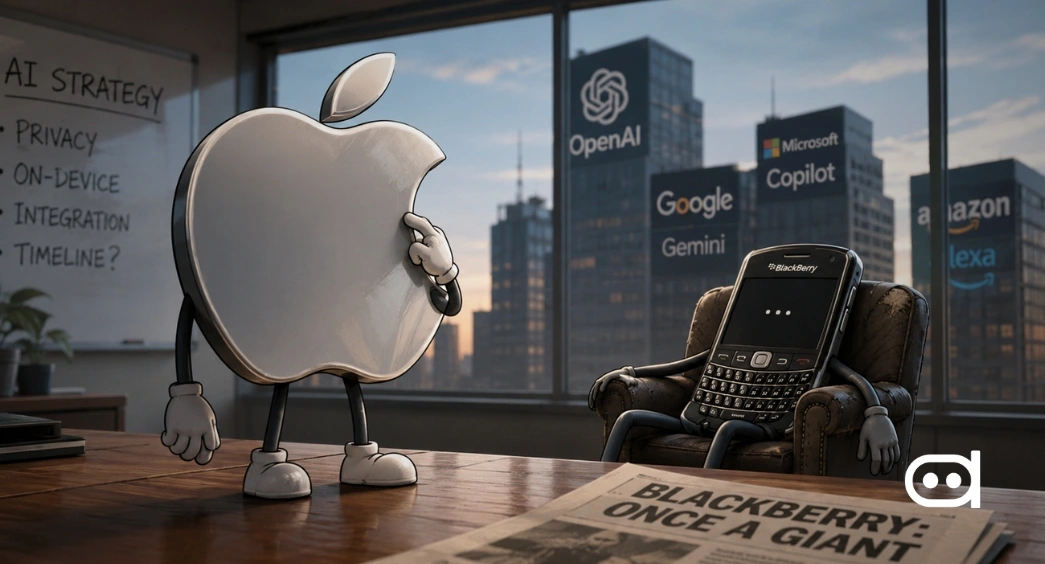
There’s a twist here that makes Apple’s AI shift even more interesting. The company’s situation feels a lot like what BlackBerry faced years ago.
Back then, BlackBerry was respected for security, reliability, and its focus on enterprise customers. But as tech shifted to touch screens, apps, and bigger ecosystems, competitors adapted quickly and pushed ahead. Security wasn’t enough to dominate the market.
Now, Apple faces a similar challenge in AI. The company puts privacy, control, and careful rollout first, while competitors go after speed, personalization, and powerful models. Siri’s next version could still launch as a beta after all these delays.
That matters because AI rewards constant trial and error, massive datasets, and fast iteration. Apple’s usual strengths: secrecy, polish, and restraint, don’t naturally fit in that kind of environment. Ironically, the philosophy that built Apple’s consumer trust could end up slowing its ability to compete in today’s fast-changing AI landscape.
Wrapping Up
Apple’s iOS 27 plans show a company caught between two worlds. On one side, there’s its reputation for privacy and tight control. On the other, the AI industry is moving fast, pushed by companies willing to use more data, offer more memory features, and build intelligence into the cloud.