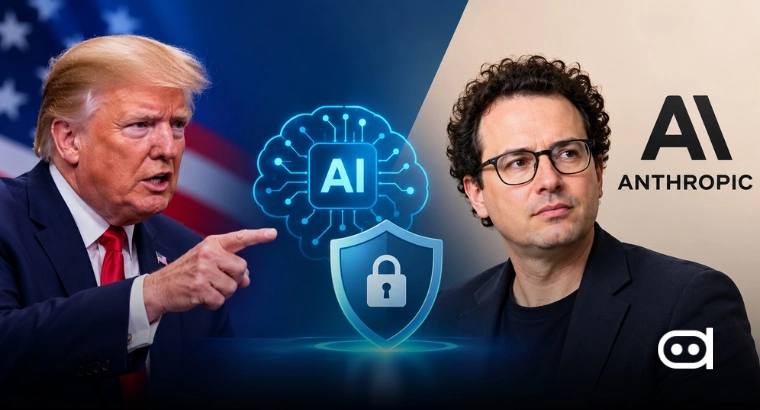
US President Donald Trump criticized Anthropic CEO Dario Amodei, after the AI executive called for a slow development of high-end LLMs. Trump denied the idea that AI needs extensive safeguards, arguing that the technology needs strong presidential leadership rather than wider constraints. His comments also play into a debate over AI safety alongside concern about data centers, regulation, and America’s competitiveness with its foes. Trump described fears that AI could eventually destroy humanity as a “HOAX” and argued that the technology and the infrastructure supporting it could become the best economic development mechanism in history.
Why is Trump Criticizing Anthropic CEO Dario Amodei?
In a series of posts , Trump targeted Amodei, accusing the Anthropic CEO to slow down AI development. Amodei recently said that the niche should tap the brakes of the most advanced models. It is so that organizations could understand the underlying issues related with the technology.
Trump had a different stance. He said the only control or “safeguards” AI needs is a “STRONG AND SMART” president. He stated that the United States already has the leadership required to stop harmful technology usage. The president said his administration had already stopped AI-related actors from committing wrongdoings. He said that the government has substantial criminal and governance powers over AI companies and hinted that those powers could continue to be used.
JUST IN: 🇺🇸 President Trump says Anthropic CEO Dario Amodei is "pretending to be a perfect little angel" for wanting to slow down AI development. pic.twitter.com/dgO8h6C31P
— Watcher.Guru (@WatcherGuru) September 14, 2026
Trump’s remarks comes as the relation between the government and Anthropic has been severed. The two sides have repeatedly clashed over the use of AI systems for military purposes. Formerly, the Defence Department deemed the firm a supply-chain problem after Anthropic sought constraints on military applications of its tools.
The newest rift also indicates a wider disagreement inside the technology niche. Anthropic and OpenAI have been among companies whose leaders have raised concerns about the problems that come hand in hand with powerful AI systems. OpenAI CEO Sam Altman and SpaceX’s CEO Elon Musk have also concurred with calls for caution around advanced models.
However, the president has consistently highlighted the need for U.S. leadership in AI, particularly when it comes to China. He argued that issues over AI taking over the world or affecting humanity are vague and unnecessary. He described those warnings as political hoaxes. The president also pushed back against criticism surrounding AI data centers in the United States. He described the criticism as part of a “sick conspiracy”, in which China would be the main beneficiary if the U.S. restricted the development of AI infrastructure.
How Could AI Regulation Affect the U.S.-China Technology Race?
Trump’s remarks come at a time when AI governance is becoming connected to the question of global leadership. The president said that the United States is ahead of China and warned against policies that could snatch that advantage. He also criticized Google’s plans to about 15.1 billion dollars in AI infrastructure in Finland. Trump said Google’s decision was influenced by difficulties obtaining permits in the United States and that the company should reshape its approach.
His comments highlight the need of AI data centers to the comprehensive AI race. Trump described AI and data centers as potentially the “ Greatest Economic Development Engine in History” placing them above industries such as oil, gold, diamonds and even the Internet in terms of probable economic importance.
Similarly, other technology firms and developers continue to discuss how quickly the industry should develop frontier AI models and what guardrails should be present. Microsoft AI researchers released a 15,000-word manifesto mentioning principles for developing AI models. Among other points, the researchers stated that AI systems should not have lawful rights and should not be designed to escape human control. They should not be allowed to deceive users. So, a certain AI system should not complete a task where doing so would necessitate violating its guiding principles.
China also does not agree to stringent restrictions on AI. Chinese Foreign Ministry spokesman Guo Jiakun criticized what he described as “ fearmongering” , arguing that these approaches could affect global AI regulation. The issue is expected to remain crucial as Trump plans for a September 24 summit with Chinese President Xi Jinping. AI is likely to be broadly speculated and questions about technology, competition, interests, and governance will be thoroughly discussed.
For Trump the focus is on maintaining AI leadership and restricting governance from slowing the growth. For AI firms and researchers such as Amodei , the challenge is how to manage upcoming risks while ensuring technical growth. The escalating disagreement shows that the debate over AI is no longer limited to the technology sector and is becoming a policy issue.