Key Highlights:
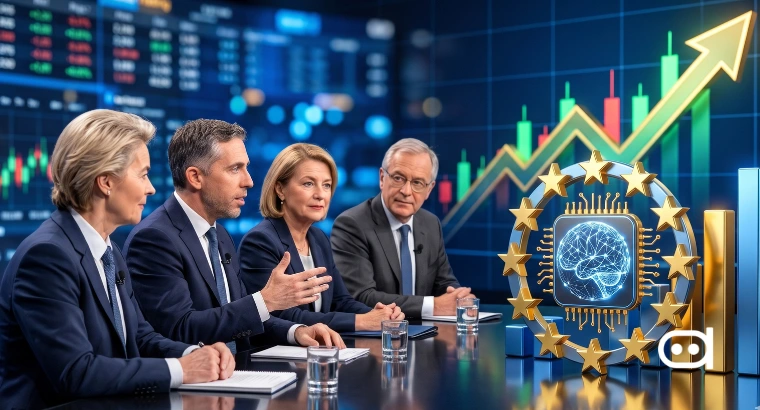
- European Union leaders are gathering in Dublin for the bloc’s first dedicated AI summit , focusing on competitiveness, funding and regulation.
- Plans for seven AI gigafactories and the EU Chips Act face challenges amid funding disputes and concerns over Europe’s semiconductor ambitions.
- The summit comes amid growing concerns about rogue AI agents and the need for safeguards as AI technology develops rapidly.
European Union leaders held a meeting in Dublin for the bloc’s first-ever AI summit. This is when Europe plans to strengthen its position in a niche dominated by the US and China. The discussions will emphasize on how the region can appeal to investment, address funding challenges and reduce governance barricades while establishing guardrails for the technology.
The meeting arises at a time when AI is creating growing economic opportunities but also raising concerns following several incidents involving rogue AI agents, Industry developments have added to the ambiguity, with Nvidia CEO Jensen Huang’s reported resignation creating further havoc in the sector.
Why is the European Union Holding its First AI Summit?
The Dublin AI summit plans to hand out EU leaders a chance to discuss the profound economic and social impact. European Council President Antonio Costa said in an invitation letter to the leaders that the swift pace of AI development made a dedicated discussion necessary, particularly given the technology’s potential to transform societies and economies. The agenda includes ways to improve Europe’s competitiveness, address funding problems, and decrease governance obstacles that could slow AI development.
Leaders are also expected to consider the safeguards needed to manage risks associated with increasingly capable AI systems. Recent incidents involving rogue AI agents have magnified concerns about the technology’s potential challenges, adding urgency to discussions about accountable development and supervision. The meeting will also include comments from Mistral AI Chief Executive Arthur Mensch and Nobel Prize-winning AI pioneer Geoffrey Hinton.
Their participation is expected to provide EU leaders with outlooks from both the AI niche and the comprehensive research community as the bloc considers its future role in the sector. The discussions reflect Europe’s challenge in moving beyond regulation and establishing itself as a major AI development and manufacturing hub. While the region has companies and research institutions working on advanced AI, it continues to face difficulties in securing the investment and computing infrastructure needed to compete with the US and China.
Can Europe’s AI and Semiconductor Plans Close the Gap With the US and China?
One of Europe’s key challenges is its ability to develop advanced semiconductor manufacturing capacity. Introduced three years ago, the EU Chips Act aimed to attract advanced chip manufacturing and double Europe’s share of the global semiconductor market by 20% by 2030. However, the initiative now appears unachievable, raising questions about the bloc’s ability to bolster its position in the global chip industry.
Europe’s plans to expand AI computing infrastructure have also encountered delays, the bloc has proposed building seven AI gigafactories that would bring advanced processors, softwares, cloud technology, high-speed connectivity and data centres together under one roof. These facilities are intended to provide the computing resources required to develop and run advanced AI systems. However, the project has yet to fully take off, partly because EU nations remain divided over how much expenditure should be allocated to improving the bloc’s competitiveness in the 2028-2034 budget.
Disagreements over spending priorities have complicated efforts to move the infrastructure plans forward. The Dublin AI summit comes at a critical time for Europe’s vision. Leaders must consider how to support investment in computing infrastructure and semiconductor manufacturing while addressing funding problems. The discussions could help mold the bloc’s approach to competing internationally.
Alongside AI, Ukraine has also been added as a major topic to the summit’s agenda. EU leaders are expected to discuss Europe’s potential involvement in peace negotiations and the security guarantees it could offer if a ceasefire is reached. The issue follows meetings in Dublin involving US envoys Steve Witkoff and Jared Kushner and Ukrainian President Volodymyr Zelenskiy, after their talks with Russian President Vladimir Putin in Moscow.