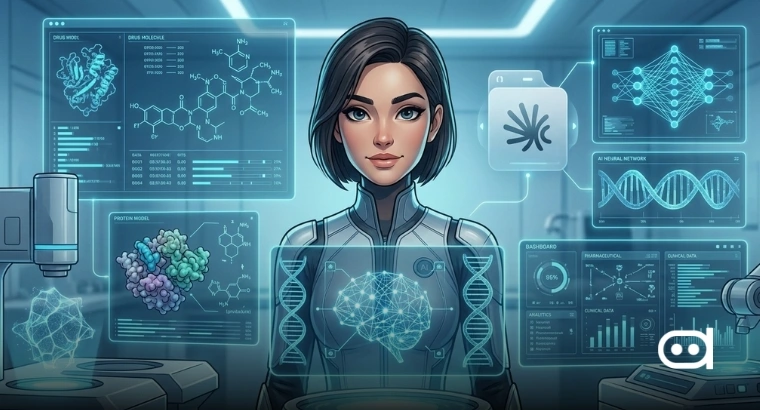
- SandboxAQ has brought its Large Quantitative Models (LQMs) to Anthropic’s Claude platform, giving researchers an easier way to tap into advanced drug-discovery and chemistry tools even if they’re not experts in computation.
- They announced it on May 18, 2026. The move is part of a bigger trend in the AI world that is pairing conversational platforms with highly specialized scientific computing engines.
- This partnership promises to speed up pharmaceutical research. Scientists can interact with powerful molecular simulation models by using natural language instead of struggling with code or running complex computing pipelines.
Artificial intelligence is changing pharmaceutical research fast, but this collaboration between SandboxAQ and Anthropic is a real shift in how all these tools might end up being used day-to-day in labs and research centers. SandboxAQ, a quantum and AI tech company that spun out of Alphabet, announced they’re integrating their LQMs with Claude.
Their plan is to open up powerful computational chemistry and molecular analysis tools to scientists who don’t necessarily have backgrounds in coding, quantum computing, or high-performance computing. Instead of complicated software suites, researchers just use conversational prompts to ask tough scientific questions, assess compounds, and dig into molecular interactions.
How AI Drug Discovery is Moving Toward Accessibility
SandboxAQ brings its drug discovery models to Claude — no PhD in computing required https://t.co/eY59DO5qha
— TechCrunch (@TechCrunch) May 18, 2026
Pharma and biotech companies have invested tons of cash into machine learning tools that help predict molecular behavior, spot promising compounds, and reduce time off drug development. The main trouble is that lots of these systems have been out of reach unless you’re at a huge organization with a big computational team and serious hardware.
SandboxAQ wants to break down that wall. Unlike basic large language models that mostly give out text, their LQMs are purpose-built for science and handle tough calculations grounded in physics. These models can study molecular structures, chemical reactions, biological interactions, and the properties of materials.
By merging this science engine with Claude’s conversational power, SandboxAQ wants to make research simpler. Instead of writing code and building simulations, scientists can just ask: “predict this binding affinity”, “compare those compounds”, “flag toxicity risks”, or “suggest molecular tweaks”, all in simple language.
The timing’s no accident, either as competition is increasing everyday in AI-powered drug research. Drug development remains one of the most expensive and time-consuming industries in the world, with timelines often stretching beyond 10 years and costs reaching billions of dollars before a treatment reaches approval.
A lot of tech companies want a piece of this space. Google-backed Isomorphic Labs is big on protein research and AI molecular biology. Startups like Chai Discovery are all-in on biological engineering and molecular prediction platforms. SandboxAQ stands out for focusing as much on usability as computational muscle.
First-generation AI platforms needed specialists to run them; now, the goal is tools that anyone can use, even if they’re not engineers. AI speeds up hypothesis generation and can show the way, but it doesn’t get rid of wet-lab experiments, clinical trials, or regulatory steps. A predictive model isn’t a substitute for actual validation.
Still, this partnership between SandboxAQ and Claude feels like a turning point. It’s not just about building stronger AI; it’s about making AI truly useful and available for regular scientific work.
Also read: Novo Nordisk Collaborates with OpenAI to Accelerate Drug Development
Conclusion
Bringing SandboxAQ’s LQMs into Claude isn’t just a new feature, it signals a bigger change in how artificial intelligence can support pharmaceutical research. Instead of locking advanced tools away for computational specialists, this partnership puts those capabilities into a conversational format anyone can use.
As companies keep looking for ways to cut development costs and speed up R&D, accessibility matters as much as power. The deal also shows how AI assistants are moving past being just chatbots, they’re becoming the gateway into real, specialized systems.