Key Highlights –
- One month after Lyria 3 launched with a 30-second track limit, Google has released Lyria 3 Pro which claims to be able to generate full 3-minute songs with structural awareness of intros, verses, choruses, and bridges
- The model is live across six platforms simultaneously i.e. the Gemini app for paid subscribers, Google Vids for Workspace customers, Vertex AI for enterprise, the Gemini API, Google AI Studio for developers, and ProducerAI for musicians
- Google states Lyria 3 Pro was trained exclusively on data it has the right to use, positioning itself against competitors like Suno and Udio, both currently in active copyright litigation with major record labels
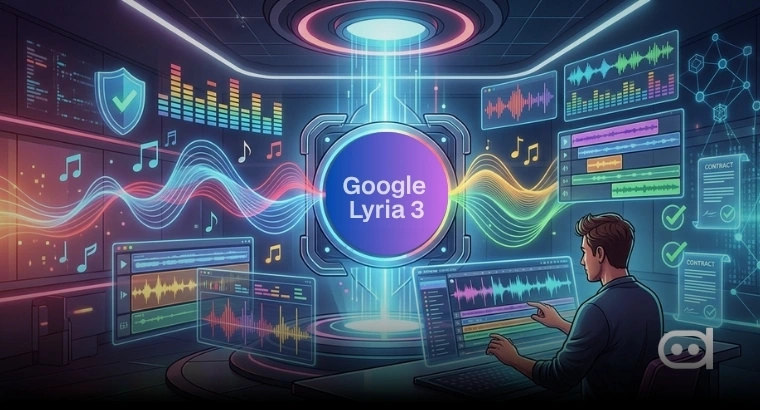
In February 2026, Lyria 3 landed in the Gemini app with a 30-second ceiling. Useful for short clips, not much else. Google has now released Lyria 3 Pro, which can now generate a full 3-minute track with enough compositional understanding to respond to prompts for specific song sections rather than just a general style direction. The model can handle complex transitions, genre experimentation, and vocal or instrumental specifications in a single generation.
The rollout covers six platforms at once. Paid Gemini subscribers access it directly in the app, with generation limits ranging from 10 to 50 tracks per day depending on plan tier. Google Workspace customers get Lyria 3 and Lyria 3 Pro inside Google Vids for custom soundtrack generation, rolling out this week. Vertex AI carries it in public preview for enterprise customers who need scalable on-demand audio. Developers can build on it through the Gemini API and AI Studio. ProducerAI, a recently launched collaborative music creation tool built specifically for musicians and producers, uses Lyria 3 Pro as its underlying model and is available globally to both free and paid users.
The Training Data Statement
The more pointed detail in Google’s announcement is not the capability upgrade. It is the explicit claim about training data.
Google stated that Lyria 3 Pro was developed using materials the company has “a right to use under our terms of service, partner agreements, and applicable law.” Every generated track carries a SynthID watermark. The model is designed not to mimic specific artists and prompting with an artist’s name draws broad stylistic inspiration rather than replicating their voice or catalog.
The context for that framing is direct. Suno and Udio, the two AI music startups with the most consumer traction, are currently in active copyright litigation with major record labels over training data. Google is positioning Lyria 3 Pro as the licensed alternative for developers and businesses that cannot afford that legal exposure. What Google will not disclose is what those partner agreements actually cover – which labels, which terms, which rights holders. The statement is carefully worded. Right to use under existing agreements is not the same as a clean copyright clearance across all downstream applications, and the lack of specifics leaves the claim harder to evaluate than the framing implies.
Also read – OpenAI Upgrades ChatGPT Shopping While Retreating From Checkout
Wrapping Up
Lyria 3 Pro is a credible upgrade and the breadth of its simultaneous rollout across consumer, developer, and enterprise surfaces is notable. For teams building audio into products who need to avoid the copyright uncertainty that currently surrounds Suno and Udio, it is now a practical option. The training data question is worth watching as Lyria scales — Google’s own past use of YouTube data for AI training has drawn scrutiny, and the current statement raises more questions than it answers.