Key Highlights
- OpenAI has launched “OpenAI for Healthcare,” a suite of enterprise tools including the new dedicated ChatGPT Health workspace and API updates specifically designed for medical institutions.
- All products are powered by the new GPT-5.2 model, which OpenAI claims outperforms human baselines in clinical tasks and was refined by a global network of over 260 physicians.
- The suite supports HIPAA compliance requirements, offering Business Associate Agreements (BAAs) and a guarantee that shared health data will not be used to train OpenAI’s models.
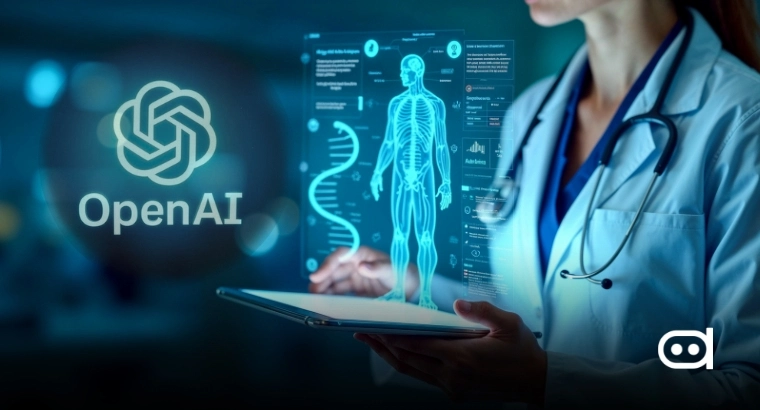
OpenAI on Friday announced the launch of “OpenAI for Healthcare,” a new suite of products aimed at assisting medical organizations with clinical reasoning, administrative documentation, and institutional policy alignment. The rollout includes ChatGPT for Healthcare, a dedicated workspace for clinicians, and an updated OpenAI API powered by the company’s latest GPT-5.2 models.
The launch targets a healthcare industry currently facing rising demand and administrative burnout. The tools are already being deployed at major institutions such as Stanford Medicine Children’s Health, UCSF, Cedars-Sinai, and Memorial Sloan Kettering Cancer Center.
GPT-5.2 and HIPAA Compliance
The new suite is run on the GPT-5.2 model, which OpenAI developed through two years of testing with 260 licensed physicians across 60 countries. According to the company, the model has been evaluated against benchmarks such as HealthBench and GDPval, where it reportedly outperformed earlier models and human baselines in real-world clinical tasks.
To address regulatory concerns, OpenAI stated that the healthcare suite supports HIPAA compliance. Organizations can sign a Business Associate Agreement (BAA) with OpenAI, ensuring that patient data and Protected Health Information (PHI) remain under the institution’s control.
A key provision of the service is that any content shared within ChatGPT for Healthcare is not used to train OpenAI’s foundational models. Security features include customer-managed encryption keys, audit logs, and role-based access controls via SAML SSO and SCIM.
Also read: OpenAI’s next Codex model codenamed “Caribou” likely built on the latest GPT-5.2
Clinical Workflows and Evidence Retrieval
ChatGPT for Healthcare is designed to handle specific medical tasks through reusable templates. These templates can automate the drafting of discharge summaries, patient instructions, clinical letters, and prior authorization requests. The system also features an evidence retrieval tool that provides transparent citations, which include journals and publication dates, drawn from peer-reviewed research and public health guidelines.
Furthermore, the system can integrate with existing enterprise tools like Microsoft SharePoint. This allows the AI to ground its responses in an institution’s specific care pathways and internal policies, ensuring that staff members follow approved standards of care. Developers can also use the OpenAI API for Healthcare to embed these capabilities directly into existing systems for ambient listening, chart summarization, and appointment scheduling.
OpenAI is collaborating with professional services firms including Accenture, McKinsey & Company, and BCG to assist healthcare providers in implementing these tools. The company stated it will continue to refine the models based on real-world data from its early hospital partners.