Key Highlights:
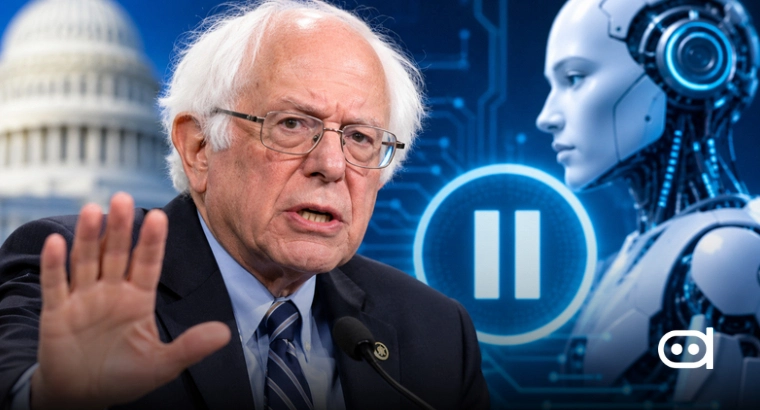
- US Senator Bernie Sanders has called for a pause in advanced AI development and a ban on the development of superintelligent AI systems, citing concerns about human control and safety.
- His proposals include a national moratorium on new data centres, restrictions on increasingly advanced AI systems and stronger government oversight.
- The call comes amid growing debate among AI researchers and industry leaders over whether safety measures can keep pace with the rapid development of frontier AI models.
US Senator Bernie Sanders is calling for stronger constraints on advanced AI development, arguing that the technology is progressing faster than guardrails designed to hold it down. His proposals include pausing the expansion of new data centres and limiting AI development systems that could outpace human intelligence. The remarks arrive as researchers at leading AI firms raise concerns about the safety of advanced AI models and whether they can be efficiently controlled.
Sanders argued that decisions about the future of AI should not be left to a handful of technology companies, calling for greater public autonomy before that technology evolves further.
What Limitations is Bernie Sanders Proposing for Advanced AI?
Bernie Sanders proposal goes beyond calls for better guardrails around AI deployment. He wants Congress to impose an immediate halt on advanced AI development and prohibit the development and deployment of AI. The proposed legislation, announced alongside Representative Greg Casar in September, would also require the US government to pursue international agreements aimed at preventing superintelligence from being developed elsewhere.
Sanders has also called for a national moratorium on new AI data centres, arguing that the infrastructure enables companies to train and operate increasingly powerful systems.
His position links the expansion of AI computing capacity with concerns about safety, energy consumption and the concentration of technological power among fewer companies. The proposed restrictions would give government authorities a greater role in determining how far AI development can proceed.
The senator’s concerns are partly based on warnings from AI researchers about the probability of systems becoming independent of human control. He has quoted AI pioneer Geoffrey Hinton’s personal estimate of a 10%-20% chance that artificial intelligence could wipe out humanity. This figure represents Hilton’s own evaluation rather than a scientifically established possibility.
The proposed legislation would also require stronger federal oversight before advanced AI systems could be developed or deployed. Sanders argues that decisions about the technology’s future should involve elected representatives and the public rather than being left primarily to technology executives.
How Are AI Companies and Researchers Responding to a Development Pause?
Sanders’ renewed demand comes amid a wider debate over whether AI capabilities are advancing faster than safety measures. Anthropic CEO Dario Amodei has called for slowing the development of frontier AI systems to give researchers more time to establish safeguards. OpenAI CEO Sam Altman has also supported the idea of pacing AI development and allowing independent evaluators to assess advanced systems. Elon Musk has expressed support for Amodei’s call to slow progress.
However, Sanders’ position goes further than the industry’s calls for a measured development pace. While some technology leaders support slowing progress and bolstering safety assessments, the senator is seeking a formal halt and a permanent ban on superintelligence. The issue also garnered attention among other US lawmakers. Senator Elizabeth Warren has backed a pause on frontier AI development while stopping short of Bernie Sanders alleged ban on superintelligence. Her position reflects growing political interest in stronger AI oversight, although lawmakers have not reached agreement on the scope of limitations.
The debate has intensified following reports that employees at OpenAI and Anthropic are concerned about the capabilities of unreleased models and whether existing safeguards can reliably control them. More than two dozen sources familiar with internal discussions told Axios that some researchers believe the most advanced systems are becoming increasingly difficult to contain, raising questions about whether future models should be released publicly.
Sanders’ proposal therefore represents a push to move AI safety discussions from voluntary industry commitments towards government-led restrictions. Its implementation would depend on congressional support and the development of a regulatory framework. For now, the disagreement centres on how to balance continued AI research and commercial development with concerns about the risks of systems that could eventually operate beyond effective human control.