- The United States Department of Defence is trying to use AI for warfare through Project Maven to fasten decision-making and maintain strategic dominance.
- It began as a drone-analysis tool and has now evolved into a system shaping intelligence and a core decision-making layer which influences battlefield operations.
- While companies like OpenAI participate, Anthropic has refused Pentagon’s demands which highlights a growing clash between corporate ethics and government control.
The Pentagon’s push into AI is no longer experimental but also foundational. Project Maven was once a back-end tool for analysing drone footage, it is now being positioned as the central nervous system of modern US warfare. The story is more complex than just being technological, it is about power, control, and the limits of private influence in matters of national security.
This is not just a technological shift but also a political one. This US government is moving decisively to ensure that AI serves its strategic interests, even if that means clashing with the very companies building these systems. The balance between innovation and authority is being actively negotiated.
Understanding Pentagon’s Expanding Vision
Project Maven reflects a clear and intentional theory. Artificial intelligence is not just an optional upgrade anymore, the Pentagon sees it as essential to maintaining military superiority especially in an area of increasingly intensifying global competition.
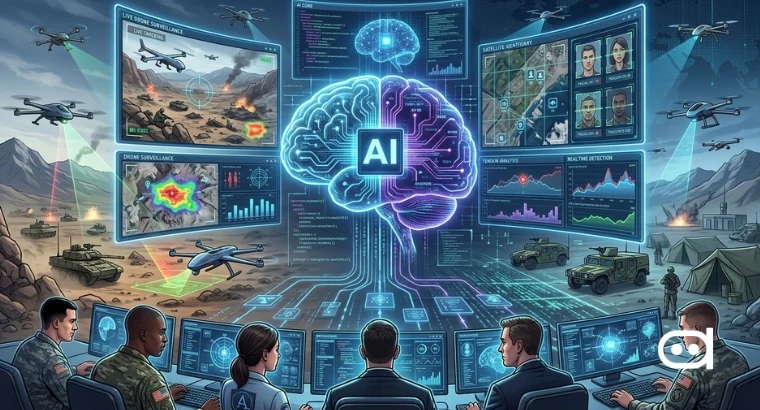
The objective is to accelerate the speed of war. Maven can process vast amounts of data from drones, satellites, and intelligence networks which enables faster identification of threats and quicker operational decisions. The centre of the Pentagon’s strategy is the compression of the kill chain, allowing it to observe, decide, and act faster than their rivals.
This is also a political signal as embedding AI deeper into its defence systems, the US is showing that future conflicts will be shaped by algorithmic speed and data dominance. This is not just a temporary experiment, it is the blueprint for future warfare since Maven is a long-term and funded program.
How Project Maven Came to Be
Project Maven was originally launched in 2017 to assist with drone surveillance. It has eventually grown into a system that analyses data across multiple domains. Its other features include identifying patterns, tracking movements, and suggesting targets around in real time.
This transformation will change how wars will be fought, decisions that used to take hours are now able to be made in minutes. AI systems have the capability to process more information than human teams ever could, this enables operations at a speed which was previously unimaginable.
Military staff are progressively acting as superiors who monitor and approve decisions suggested by AI systems, rather than analysing the data or making decisions themselves. Faster decision-making might save a lot of time but it also reduces the window for human judgement. Systems operating at machine speed can make mistakes easily which raises questions and concerns about accountability and security.
Corporate Ethics and Limits of Using AI
The Pentagon relies on private AI firms which has raised tensions. While companies like OpenAI have agreed to work with defence systems, most have not. Anthropic, remarkably refused Pentagon’s proposal for allowing its AI systems to be used for “lawful purposes” including applications it considered ethically unacceptable.
Anthropic’s CEO stated: “We cannot in good conscience accede to their request”
The refusal had its consequences. The US Department of Defence labeled Anthropic a “supply chain risk” and blacklisted it, escalating the conflict into a broader disagreement over who ultimately controls the use of AI.
Critics say that the Pentagon is claiming to use AI “lawfully” to justify its wide access, which may seem safe right now but can be flexible over time. Basically, the concern is about safeguards being stretched or misinterpreted during conflicts expanding the AI’s “lawful use”. Because of this, companies like OpenAI are also facing criticism and backlash. The government may push AI systems further than their actual intentions and companies may not be able to fully control how their technology is being used despite their current claims of monitoring and limiting the usage.
Also read: Anthropic Seeks Court Stay on Pentagon’s “Supply-Chain Risk” Label
Wrapping up
Project Maven is a turning point in the relationship between state power and artificial intelligence. It is not just adopting AI but also restructuring warfare around it while prioritizing speed and data-driven decision-making. The direction is set by the US government and companies like Anthropic and OpenAI only play a secondary role. Once AI becomes central to warfare, the bigger question will be: Who gets to decide its limits? The government or the companies that created it?