Key Highlights:
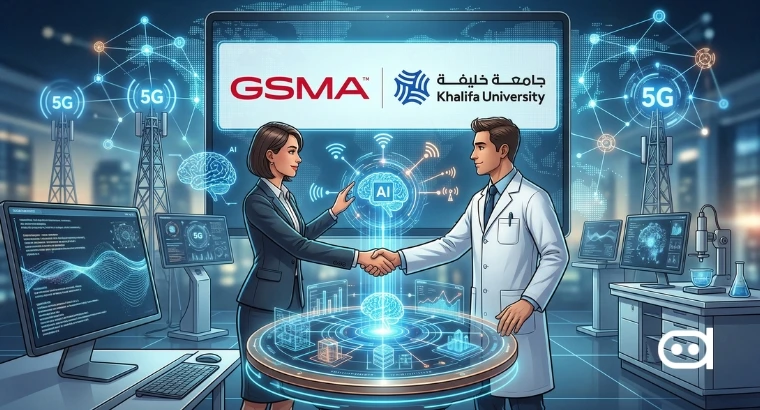
- GSMA and Khalifa University are collaborating to test and develop telecom-centric AI models which are aimed to improve network operations.
- Their major focus is to build and standardize tools like TelecomGPT to address gaps in handling of telecom data and systems by current AI.
- They’re evaluating performance, reliability, and practical implications in telecom networks through real-world testing environments.
GSMA and Khalifa University collaborating is a sign of growing recognition in the telecom sector since general purpose artificial intelligence is not yet equipped to handle the complexity of real-world network operations. Even though AI has made constant progress in user-oriented applications, its capabilities remain limited when it comes to operating highly technical systems.
The development and testing of TelecomGPT is the centre of this initiative to improve network operations. TelecomGpt is a domain-specific AI system for the better understanding of telecom standards, systems, and everyday operational challenges. The effort is not just to create a model but to create frameworks, datasets, and benchmarks to see if AI is able to perform telecom specific tasks with less human intervention and minimal mistakes.
General AI’s Inability to Meet Telecom Standards
One of the major issues being highlighted is the inability of existing AI systems to interpret telecom data and standards reliably. Highly specialized protocols and documentation are operated on in telecom networks, they’re often technical and quite difficult for even experienced engineers to navigate.
The present AI models that are usually trained on internet data, struggle in the telecom domain and might lead to AI hallucination; which means there are high chances of these models interpreting wrong technical data or generating incorrect outputs. These errors might be tolerable in applications which do not possess high risk, but they bring significant challenges in the telecom industry where inaccuracies often lead to service disruptions. Existing AI models are not yet capable of handling the level of precision which is required for the real-world implementation in telecom.
Building and Testing of TelecomGPT
To address and eliminate these challenges, the collaboration is focused on training TelecomGPT using only telecom-specific data rather than general internet sources. This includes structured inputs such as:
- Telecom standards
- Domain-specific datasets
- Better understanding of technical language
- Network logs
Another key element is the use of knowledge graphs. They organize telecom standards into structured formats making it easier for AI systems to process them more effectively. This improves reasoning and reduces errors while interpreting complex information.
Dedicated evaluation frameworks are also under development, they’re meant to test how well the model performs in tasks such as troubleshooting, interpreting documentation, and supporting technical operations. Hence, real-world testing environments play a very important role in this process. By creating an environment with actual network conditions, researchers can evaluate how TelecomGPT performs under real and practical situations. This will help ensure that the results go beyond theoretical accuracy and reflect real reliability while operating.
Also read: Wipro Unveils TelcoAI360: Transforming Telecom with AI Power
Wrapping Up
The initiative taken and work being done by GSMA and Khalifa University portrays a shift in the development of artificial intelligence; moving from broad, general-purpose systems to highly specialized, domain-specific systems.
TelecomGPT is an effort to eliminate the gap between the capabilities of artificial intelligence and its real-world usage in telecom networks. The initiative aims to create systems that can operate reliably in one of the most critical and complex digital environments.
The success of this initiative has the power to influence how artificial intelligence is deployed across other complex and critical sectors beyond the telecom industry. Industries such as healthcare and finance face similar challenges when it comes to accuracy and reliability. If TelecomGPT is a success and shows measurable improvements in handling complex systems, it may serve as a model or a blueprint for development of any future domain-specific AI systems. For now, the model remains being tested till it reaches the level of specialization required to make it truly effective and reliable in real-world environments.