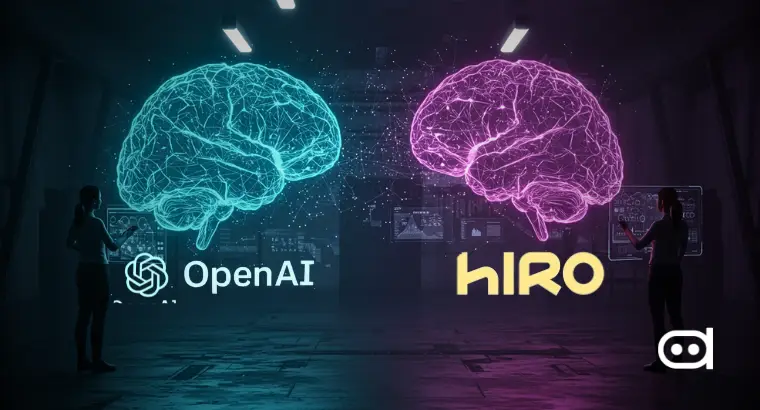
- In an undisclosed deal in April 2026, OpenAI acquired AI personal finance startup Hiro, aiming for a strategic expansion in fintech.
- Hiro is expected to shut down within days of the announcement and has already scheduled the deletion of user data.
- OpenAI’s main ambition is to evolve ChatGPT into a real world decision making assistant which includes financial planning.
OpenAI purchasing Hiro, a young AI powered personal finance startup, marks a subtle shift in the company’s long term course. The deal was announced on April 13, 2026 and it did not include any financial details. But, it seems like OpenAI is more interested in the team and underlying technology than in continuing the service itself as it shutdown Hiro’s product immediately. Most of the major AI firms acquire niche startups to speedup capabilities in specific domains just like OpenAI did, hence this approach aligns with this growing pattern.
Ethan Bloch founded Hiro in 2023, it was backed by well established fintech investors and developed tools designed to help users understand their financial futures better. The platform focused on predictive modeling which allowed users to simulate scenarios such as increasing savings, managing debt differently, or adjusting spending habits instead of just simply tracking spending or categorizing expenses. This forward looking approach was particularly attractive in an AI driven landscape as it was very different from traditional budgeting apps.
From being a Source of Information to Guiding Decisions
This acquisition shows a broader change undergoing at OpenAI. The company is increasingly focusing on creating tools that can actively guide users through complex decisions rather than solely building systems that respond to prompts. Personal financing includes continuous trade offs, uncertainty, and long term planning, all these areas are where AI can offer meaningful and useful support making personal finance a natural extension of this vision.
Hiro has capabilities that align very closely with this direction. Reports say that its tools were built to help users know the consequences of different financial choices before committing to them by answering all the “what if?” questions. Integrating such features into the app could wrap up ChatGPT’s utility and bring it closer to a personal advisor, rather than an informal assistant. It would represent a significant shift in how humans interact with AI in their daily lives.
In this competitive landscape, where AI companies are constantly trying to outdo each other at cutting edge tech and raw model performance, functionality and real world impact are becoming a greater priority. OpenAI could potentially position itself against fintech platforms, robo advisors, and even traditional financial institutions by integrating financial intelligence into its ecosystem while it already has the leverage of its massive user base.
The Risks and Realities of Personal Finance in AI
While personal finance has become a growth industry, that growth adds a new layer of complexity, and risk. Financial data is among the most valuable and sensitive forms of user information, meaning any platform that processes it should be able to adhere to high standards of privacy and security. As its influence tightens, OpenAI would need to tread carefully with user trust and regulations.
Concerns about data transfer could be addressed with the help of the immediate and planned shutdown of Hiro and the deletion of its user data. The disruption experienced by existing users highlights a common challenge with acquihires. Even though these changes are important for strategic growth, they can leave users hanging and also raise questions about long term reliability.
Also read: OpenAI is Planning to Set up its First Permanent Office in London
Wrapping Up
The acquisition of Hiro might not change headlines on a larger scale for tech deals but its implications are far reaching. OpenAI is intent upon moving beyond conversational AI, and into systems that can actively shape decisions in critical areas like personal finance. predictive, scenario based tools will help the company to position itself to become more deeply embedded in users’ daily lives. How well it works will depend on execution of this strategic approach. If OpenAI can clear concerns such as trust, accuracy and regulatory compliance, it makes this acquisition the earliest shot at a future where decisions are taken for you, not information given.