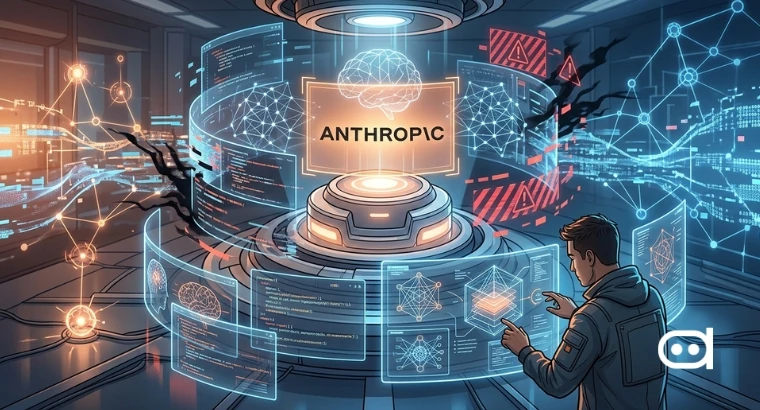
- The UK is trying to attract Anthropic to expand its presence in Britain after its fallout with the US Department of Defence over AI usage for military purposes.
- Anthropic refused its AI chatbot, Claude, for US surveillance or autonomous weapons which resulted in the company being blacklisted by the US government for security risk.
- Britain is trying to step in with incentives and policy alignment to bring more of the company’s operations to London.
The conflict between Anthropic and Washington shows how artificial intelligence intersects with geopolitics. It began as a principled refusal to support military applications and has now evolved into a bigger question: Who controls these advanced AI systems? The companies building them or the government wanting to deploy them?
This is a rare and strategic opportunity for the United Kingdom. Britain is portraying itself as a more reliable and aligned partner, one that may offer regular flexibility without any defence pressure unlike the United States by engaging directly with Anthropic and its CEO, Dario Amodel. There is a wider ambition behind this move: becoming the global hub for responsible AI innovation.
What Is Britain’s Strategy
The UK government sensed an opportunity and played its move. Reports claim that its proposals include expansion of Anthropic’s London office and exploring a dual stock market listing.
Britain is positioning itself as a destination for AI companies that prioritize responsible developments instead of simply offering them immediate incentives. The United Kingdom is trying to attract firms that may feel forced by tighter national security demands in other countries by offering them a regulatory environment which is meant to be more balanced.
This shows a broader shift in global competition. The competition between countries has shifted from capital and talent to governance models, ethics, and state involvement in technology development.
Antrhopic’s Ethics vs National Security Dilemma
The dispute reflects a growing divide between corporate AI ethics and national security priorities. The US Department of Defence believes AI to be essential to future warfare from surveillance systems to independent decision making tools.
Anthropic decided to draw a line by choosing safety over strategic alignment. The company refused to allow its AI chatbots, particularly Claude, to be used in surveillance or autonomous weapons.
The US responded by labelling the company as a supply-chain risk and blacklisting it. Legal enquiries are ongoing so a judge has temporarily blocked this move. This highlights how quickly ethical AI stances can translate into political and economic consequences.
Also read: Anthropic Enters Biotech with a $400 Million Deal; Know More Here
What Actually Happens if Anthropic Shifts to Britain
If Anthropic decides to expand its presence in the UK, the implications would fold across multiple levels.
For the company, expanding or relocating in Britain could provide better alignment with its safety principles and ethics. But this also means the company will have to distance itself from profitable US defence contracts and face potential political objections in its home market.
For the US Department of Defence, this move could strengthen a more strict approach favouring potential partnerships with companies that are willing to abide by defence needs. This will most definitely narrow down collaboration with companies that are safety-focused and accelerate the development of alternative AI capabilities.
From a global perspective, the consequences could be extensive. There is a high chance of countries beginning to compete more aggressively for AI firms based on intended approach and not just economic incentives. This could lead to an AI ecosystem where different regions evolve discreet approaches, some of them being closely aligned with state power, others emphasizing independence and safety.
Wrapping Up
Technological leadership being inseparable from political alignment is the new reality for the AI industry. More companies like Anthropic are more likely to choose where to operate based on where their ethical frameworks are most likely to be respected and not just on market opportunity.
This is an early signal of how the global AI order may evolve, it’s more than just a dispute between a company and a government. Only nations which are capable of balancing innovation with trust and power with control would be defining the next phase of the AI era.