With Google Opal AI, an experimental tool that assists users in making light “mini-apps” by means of a visual, AI-assisted workflow, Google has quietly made its entrance into the expanding universe of AI-powered app development. Opal places itself in the middle of rush coding, no-code platforms, and AI app creators, growing as a fast and user-friendly way to prototype functioning micro-apps without needing a lot of engineering.
Google Opal AI does not compete with full-stack app builders directly. Instead, it stresses speed, simplicity, and logic-driven workflows. This makes it very appealing to startups, marketers, educators, and small to medium businesses that need quick internal tools or want to prove their concept with a small app. However, the critical question is indeed whether Google Opal can develop and mature from being just an experimental project to a true intelligent mini-app engine.
Fast Take on Google Opal AI
Opal AI, at first glance, looks like Google’s reply to the growing trend of AI-driven app creation and vibe coding tools. The platform caters to fast building, logical flow design, and AI-assisted generation rather than a polished UI or production-ready deployment. For small and medium businesses, this can be very beneficial, especially for internal tools, demos, and workflow automation experiments.
The first thing that comes to mind is that Google Opal AI is a powerhouse when it comes to quickly producing small but fully functional applications. With the Google Opal AI tool, you can easily define the areas of input, determine how the data should be processed, and what the output will be without using the usual coding methods. Nevertheless, there is no doubt that Opal is the ultimate choice for lightweight use cases only. It is not intended to take the place of full-scale app frameworks or the builders of consumer-oriented products.
What Is Google Opal AI?
Google Opal AI is a trial AI application creator that uses a structured, block-based interface together with generative AI to create mini-apps. It is one of the first tools in Google’s experimental AI lineup and is still at the experimental stage, suggesting that the features, performance, and availability might change. The Google Opal AI app builder lets users visually define user inputs, AI generation steps, and outputs in a flow. It is the perfect instrument for rapidly conducting tests, validating workflows, or gaining insight into the structure of AI-powered applications.
Let’s Build with Opal AI
To evaluate the practical use of Google Opal AI, we decided to test it by creating two mini-apps and then drawing practical conclusions based on these tests.
1. The Outfit Advisor

The Outfit Advisor is an app dedicated to being the user’s personal stylist and choosing the most appropriate outfit from the user’s wardrobe for a particular occasion. The process starts with the user specifying an event, like an office party, wedding, or casual outing. Next, the user has to upload photos of the clothes choices.
The app chooses the most appropriate outfit and finally outputs a recommended look as an image. A highlight of this test is that the Google Opal AI app builder is capable of handling conditional logic, image input, and AI-driven decision-making smoothly.
2. Social Trending Post Finder
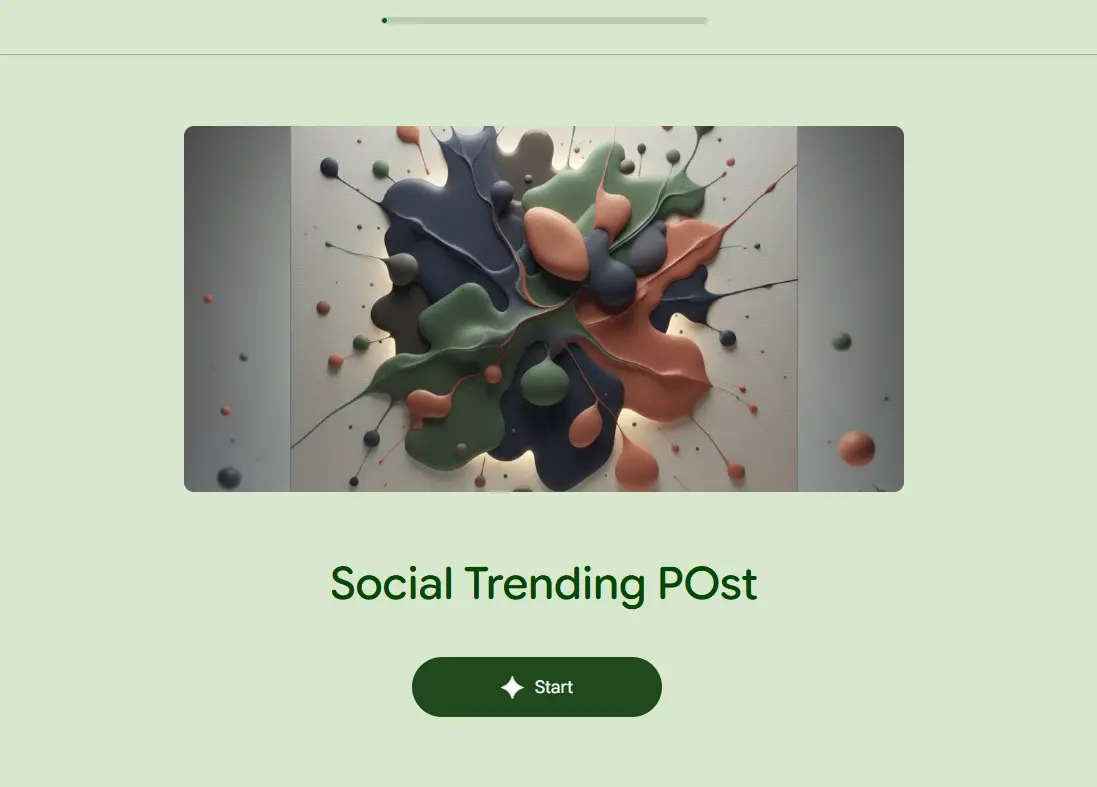
The application, Social Trending PostSocial Trending Post mini app by Opal AI, is designed to bring trending posts from three main platforms: Instagram, X (formerly Twitter), and TikTok, and display them in one convenient location for users. The users can choose both the platform and the industry that they want to get the trending content for, and the app gets back with the relevant posts that are trending.
Performance Summary
The overall performance was quite satisfactory. The logic structure did quite well, and output accuracy was decent. Nevertheless, the UI creativity was low, which pointed out the fact that at present, Opal design is more function-oriented than creative.
Google Opal AI App Builder Features & Capabilities
- Still in an experimental phase, resulting in a limited but intelligently structured feature set
- Provides access to a collection of already published mini-apps for reference and learning
- Allows users to study real workflows and understand best practices through existing app examples
- App creation is structured around four core elements: User Input, Generate, Output, and Add Asset
- Logical flow remains transparent, making the builder accessible for non-developers
- Offers a console view for inspecting underlying logic, useful for learning and debugging
- Includes basic theming options with one-click appearance changes such as minimal and glass-style themes
- Visual customization is present but remains shallow in depth
Where Opal Falls Short
- Gemini-powered model responses can be slow, particularly when handling images or complex logic chains
- Performance lag reduces suitability for real-time or live interaction use cases
- Apps generated tend to be visually flat with basic backgrounds and gradients
- Lacks a formal publishing process, deployment pipeline, or version control system
- Apps can only be shared via public links
- No support for integrations with GitHub, external APIs, or third-party services
- Absence of integrations significantly limits scalability and long-term extensibility
Alternatives to Consider
For individuals who require more powerful tools, a number of options are available. v0.dev excels at UI-focused app generation. Claude and ChatGPT provide more advanced reasoning and a more sophisticated conversational app logic. Besides, Gemini AI Studio offers unrestricted access to the AI models of Google, whereas Lovable is all about providing refined no-code experiences.
Is Google Opal AI Truly a Smart Mini-App Engine?
Google Opal AI, in its present state, is a tool that has potential but is still too much of an experiment. It works best as a rapid prototyping platform for micro-apps, internal tools, and learning AI app workflows. It does not reach the mark in terms of design, speed, and integrations, but its structured logic system and user-friendliness still give it a place in early-stage testing as a valuable tool.
If Google gradually strengthens Opal AI by offering better performance, more deployment options, and superior integrations, it may turn into a truly smart app development engine. Presently, Opal AI can best be considered as a sneak peek into the future lightweight, AI-first app creation process that Google has in mind.