Key Highlights
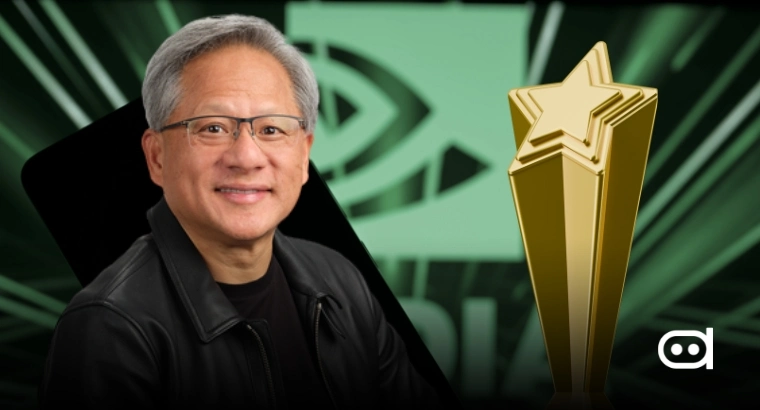
- IEEE has named Jensen Huang as the recipient of the 2026 IEEE Medal of Honour, its highest award.
- Huang is being recognised for shaping accelerated computing, a field that underpins modern AI training and deployment.
- The award includes a $2 million prize, marking the second year IEEE has attached a monetary component to the honour.
IEEE Honors NVIDIA’s Jensen Huang for Building the Hardware Backbone of AI
The IEEE has awarded its 2026 Medal of Honor to Jensen Huang, founder and CEO of NVIDIA, recognising his long-term role in establishing accelerated computing as the foundation of modern artificial intelligence.
The announcement was made on January 6, 2026, during a media event at CES in Las Vegas, placing the recognition on one of the industry’s most visible global stages. While the Medal of Honor is traditionally framed as a lifetime achievement award, Huang’s selection reflects something more specific: the central role NVIDIA’s hardware now plays in the AI economy.
NVIDIA CEO Jensen Huang was named the 2026 IEEE Medal of Honor recipient, recognizing pioneering leadership and groundbreaking contributions to technology.
— NVIDIA Newsroom (@nvidianewsroom) January 7, 2026
From science and medicine to modern AI, the honor reflects how NVIDIA helps shape the standards and infrastructure powering… https://t.co/lSKGpk9wbE
From Graphics Chips to AI Infrastructure
NVIDIA’s invention of the graphics processing unit (GPU) in 1999 was initially aimed at improving computer graphics. Over time, GPUs have proven to be uniquely suited for parallel processing, making them ideal for training machine learning and deep learning models.
That shift has accelerated general-purpose computing using specialised hardware and has become one of the defining characteristics of modern AI. Today, GPUs sit at the core of large-scale model training, data centres, and what NVIDIA now calls AI factories.
The company’s rise mirrors this transformation. NVIDIA became the first firm to cross a $5 trillion market capitalisation in October 2025, driven largely by demand for AI compute rather than its original gaming business.
Why IEEE Is Recognising Huang Now
IEEE’s decision comes at a moment when AI infrastructure is as strategically important as AI models themselves. As governments, cloud providers, and enterprises compete to secure compute capacity, NVIDIA’s early bet on accelerated computing has shaped how AI systems are built worldwide.
Huang’s work also extends beyond hardware. NVIDIA’s CUDA platform helped standardise GPU computing for developers, locking in a software ecosystem that remains difficult for competitors to replicate.
Previous IEEE Medal of Honor recipients include figures behind the internet, GPS, and modern semiconductor manufacturing. Technologies that quietly underpin daily digital life rather than sit at the consumer-facing layer.
Awards, but Also Market Reality
Huang has received multiple high-profile recognitions in recent years, including honours from the Financial Times, TIME Magazine, and the Queen Elizabeth Prize for Engineering. The IEEE Medal of Honor, however, is notable for its technical framing rather than cultural visibility.
For IEEE, the $2 million prize attached to the award signals a broader shift: acknowledging that foundational engineering decisions now carry economic and geopolitical weight, particularly in AI.
Compute Is Becoming the Competitive Moat
Beyond individual recognition, Huang’s award highlights a structural shift in the AI industry: access to computing power is now a defining competitive advantage. As AI systems become more resource-intensive, control over specialised chips, manufacturing capacity, and supply chains increasingly determines who can build and deploy advanced models at scale. NVIDIA’s dominance at this layer has positioned it as a gatekeeper of AI infrastructure, shaping how AI capabilities are distributed across companies, countries, and sectors.
Also Read: A Complete Roundup of the Major AI Model Releases in 2025
What This Signals for the AI Industry
Huang’s recognition also points to a broader change in how AI progress is measured. The industry is moving beyond a sole focus on algorithms and model architecture, toward systems design, how hardware, software, and data work together efficiently. While new models continue to attract attention, the ability to train and run them at scale remains constrained by physical infrastructure.
By awarding Huang, IEEE is effectively acknowledging that the future of AI will be defined not just by smarter models, but by who can build and maintain the underlying systems that make large-scale intelligence possible.