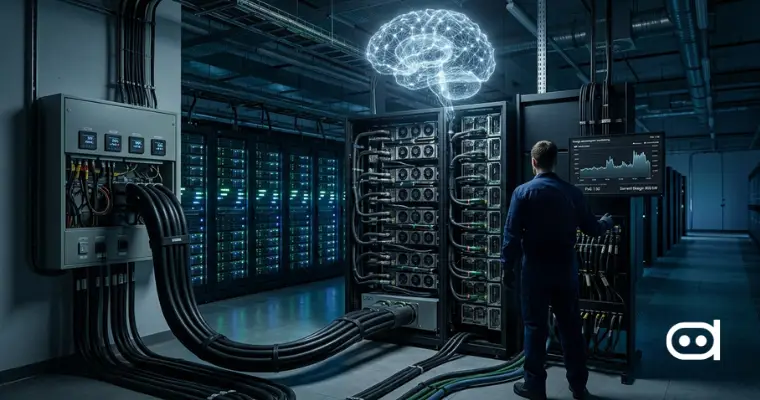
Artificial intelligence has evolved from its initial niche status into a fundamental technology that drives innovation across all business sectors, including healthcare, finance, entertainment, and manufacturing. The computing power requirements of organizations that implement AI technology have increased exponentially as they expand their use. Intelligent systems rely on a large network of servers, GPUs, and data centers that operate continuously to handle data processing and model training.
The rapid growth of artificial intelligence technology has made AI electricity consumption a topic of major importance. As organizations develop extensive AI systems that need substantial computer resources, concerns about AI energy usage and its environmental effects are increasing.
So, how much energy does AI use in reality?
Why AI Models Require So Much Electricity
Advanced AI models particularly require extensive computing resources because their data processing needs and system complexity consume substantial computational resources. Modern models require training with billions to trillions of parameters, which require multiple processing cycles for precise results. The system generates continuous high-demand processing needs, resulting in rising AI energy usage.
The second element that affects performance is parallel processing capabilities. The system accelerates training by the simultaneous operation of thousands of GPUs, which results in higher GPU power consumption for AI. The systems operate continuously during their extended runtime, which can last weeks to months, increasing AI electricity consumption rates. AI requires fast storage solutions, advanced networking capabilities, and immediate access to real-time data, which together drive energy consumption in machine learning systems.
How AI Model Training Works
Data Processing and Preparation
The training process requires organizations to gather complete datasets before cleaning and structuring them. The process requires sorting, labeling, and transforming data into a usable format. This phase requires less energy than actual training, but it still adds to AI energy usage over handling and storing large amounts of data.
Training Large Language Models
The core of electricity used in AI training lies in this phase. The system builds large language models through training processes, using extensive datasets and runs multiple learning cycles to change their model parameters. The process requires enormous computational resources because every iteration needs back and forward propagation. The system reaches its maximum GPU power consumption for AI when thousands of processors operate simultaneously to achieve optimal performance. The training process runs for multiple days or weeks to complete because the model size determines the duration, making training the most power-consuming part of the procedure.
Testing and Optimization Phases
The testing process begins after initial model training, including model testing, fine-tuning, and optimization work. The engineers validate system performance by conducting multiple tests, identifying system faults, and enhancing system operation. The procedures require less power than complete training, but they still increase total AI electricity consumption because models need multiple retraining sessions to reach production standards.
How Much Electricity Does AI Training Actually Use?
The estimation for AI electricity consumption should consider both the model dimensions and its operational complexity. The smaller AI systems have limited energy needs, but the larger models demand vast amounts of power to operate. The training process for a cutting-edge language model requires more than 300 megawatt-hours of electricity for its operations. Some estimates suggest that training a single advanced model can use as much energy as hundreds of households consume annually. The rising expenses associated with AI training energy costs have become a pressing issue that affects environmental sustainability.
The major AI companies maintain extensive data centers that operate as dedicated facilities for their model training operations. The power these facilities consume creates a substantial impact on worldwide data center energy consumption. The total energy demand will continue to increase as more people adopt AI technology.
What Drives the Cost of AI Training
AI model training expenses depend on various operational requirements and infrastructure elements, which must be established first. The financial costs for maintaining extensive systems increase with the rising power needs required to run artificial intelligence.
GPU and Hardware Power Consumption
AI training requires high-performance GPUs, which serve as its fundamental processing units. These processors use a lot of power when they run their maximum functions continuously throughout the day. The total power that AI systems consume increases with each additional GPU used for training purposes, resulting in higher costs associated with training AI models.
Data Center Infrastructure
AI training requires specialized data centers that contain essential servers, networking equipment, and storage facilities. These facilities contribute heavily to data center energy consumption, as they must support continuous, high-performance computing environments. The costs of infrastructure development include both hardware expenses and costs required for system maintenance and daily operation.
Cooling Systems and Energy Overhead
One often overlooked factor is cooling. High-performance computing creates large amounts of heat, which requires advanced cooling technology to sustain its ideal operating temperature. These systems create additional power requirements, which drive up both AI training energy cost and total electricity consumption.
Electricity Pricing and Cloud Compute Costs
Electricity costs vary by region, which impacts the overall expenses required for AI training. Many organizations rely on cloud providers, where pricing includes both compute and energy costs. Organizations need to adopt cloud-based AI systems because these technologies will determine their financial requirements and operational growth potential.
How Companies Are Reducing AI Energy Consumption
The rising concerns about AI electricity consumption have prompted companies to investigate methods for decreasing both their environmental damage and their financial costs.
Energy-Efficient AI Models
Researchers are developing more efficient algorithms that require fewer computational resources. The combination of model pruning and quantization, together with optimized architectures, enables a decrease in AI power consumption, which maintains essential system functionality.
Green Data Centers
Many organizations are investing in energy-efficient data centers designed to minimize data center energy consumption. The facilities achieve energy reduction through the implementation of advanced cooling technologies, the deployment of more efficient hardware, and the optimal management of resources.
Renewable Energy for AI Infrastructure
A growing number of companies are powering their AI operations with renewable energy sources such as solar and wind. This shift not only reduces carbon emissions but also aligns AI development with sustainability goals.
The AI in energy field has achieved new progress, which enables improved power management throughout all infrastructure systems. The combination of these methods establishes an essential pathway that enables organizations to make their AI systems environmentally friendly throughout their future operations.
Final Verdict
The fast expansion of artificial intelligence technology has created a major problem for companies and government officials through its impact on AI electricity usage. Artificial intelligence provides high-value solutions but requires extensive energy consumption for its large model training processes. The process of balancing sustainable development with present-day technological advancements requires knowledge about AI energy consumption and expenses associated with training AI models.
Future AI development will depend on efforts to decrease AI power usage through advanced models, environmentally sustainable systems, and renewable power sources, as per ongoing technological advancements. Ultimately, the challenge is not just how much energy AI uses, but how responsibly it is managed.